Jennifer Ewing: Biography, Acting Career, Artistic Journey, and Creative Achievements
Introduction to Jennifer Ewing
Jennifer Ewing is a multidisciplinary artist whose professional life reflects a deep connection with theatre, visual arts, storytelling, and creative collaboration. Known for working across several artistic disciplines, she has developed a career that combines acting, fine art, scenic painting, directing, producing, dramaturgy, and dialect coaching. Her work demonstrates how different forms of artistic expression can complement one another, creating opportunities to tell meaningful stories through performance and visual design.
Based in Seattle, Washington, Jennifer Ewing has participated in theatrical productions with established regional companies and has pursued her interests in painting and other visual arts alongside her work onstage. Her professional background illustrates the value of versatility in the performing arts, where an understanding of acting can strengthen a person’s approach to stage design, while experience in visual art can contribute to a deeper appreciation of atmosphere, composition, and character.
One of the defining aspects of Jennifer Ewing’s career is her interest in stories that highlight women’s experiences and perspectives. Her approach to art extends beyond a single medium, allowing her to explore human emotions, relationships, historical settings, and personal experiences in different ways. Whether contributing to a theatrical production or creating a fine-art piece, she brings together technical knowledge and an interest in the expressive possibilities of art.
Although Jennifer Ewing may not be a household name among mainstream entertainment audiences, her work belongs to a professional artistic environment in which collaboration, preparation, and creative experimentation are essential. Understanding her career requires looking at both her theatrical achievements and her development as a visual artist.
Early Interests and Creative Background
Jennifer Ewing’s artistic background reflects a long-standing interest in creative expression. She grew up in Port Townsend, Washington, a coastal community with an established artistic atmosphere. Exposure to an environment where creative activities were valued helped shape her interests and encouraged her to explore different forms of art from an early age.
Her family heritage also includes people involved in artistic and creative professions, including singing, painting, ceramics, writing, photography, filmmaking, and music. Such a background provides important context for understanding her later interest in multiple disciplines. Rather than restricting herself to one creative activity, she developed a professional path that allows different artistic interests to exist alongside one another.
During her school years, Ewing attended art classes and developed an interest in visual expression. Early opportunities to draw, paint, and explore artistic techniques can provide a foundation for later professional work, particularly when combined with curiosity and continued practice. In her case, visual art remained an important part of her life even as she moved toward formal theatrical training.
Her subsequent career demonstrates that artistic development does not always follow a straight line. An individual may begin with an interest in painting, pursue acting professionally, and later discover new opportunities through scenic design or production work. Ewing’s professional experience reflects this interconnected approach to creative development, with each discipline contributing something different to her overall practice.
Publicly available biographical information provides details about her artistic interests and professional activities, but it does not establish a complete account of every aspect of her childhood or private life. Her documented creative journey is therefore best understood through her education, artistic influences, theatrical experience, and professional projects.
Education and Classical Acting Training
A significant milestone in Jennifer Ewing’s professional development was her education at the American Academy of Dramatic Arts in New York City. She graduated with honors from the institution, which is associated with professional training in acting and performance.
Formal acting education can help performers develop a broad range of skills. These may include vocal control, physical expression, character interpretation, scene study, stage presence, and the ability to communicate a character’s motivations to an audience. Such training also introduces actors to the discipline required for rehearsals, collaboration, and live performance.
Classical acting training is particularly relevant to performers interested in historical and period productions. These works often involve unfamiliar speech patterns, historical conventions, heightened language, and character relationships that differ from those found in contemporary drama. An actor must understand not only the words being spoken but also the social and emotional circumstances that shape a character’s choices.
Ewing has expressed a particular interest in historical and period pieces while also collaborating on contemporary original plays. This combination allows her to work with different styles of writing and performance. Classical theatre can demand close attention to language and structure, whereas contemporary drama may explore modern relationships, social questions, and personal conflicts through more familiar speech.
Her educational experience also helped establish a professional foundation that could be applied beyond acting. Theatre training can be useful in several related roles because productions depend on a shared understanding of scripts, characters, dramatic structure, and the practical requirements of performance.
For someone who works in acting, directing, dramaturgy, and scenic art, this broad perspective can be especially valuable. Each role involves a different responsibility, but all contribute to the creation of a coherent theatrical experience.
Jennifer Ewing’s Career as a Theatre Actress
Acting is an important part of Jennifer Ewing’s professional identity. Her theatrical career includes performances with regional companies and theatre organizations in Seattle and elsewhere. These opportunities have allowed her to participate in productions spanning classical plays, adaptations, contemporary drama, and other theatrical forms.
Theatre acting requires a combination of preparation and responsiveness. Performers must understand the text, develop believable characters, work within a director’s interpretation, and respond to the timing and energy of fellow actors. Unlike film performances, which can be recorded in multiple takes and assembled through editing, stage acting generally unfolds continuously before a live audience.
This environment makes rehearsal, concentration, and consistency particularly important. Actors must maintain their performance while adjusting to the circumstances of each show. Even when a production follows a carefully prepared script, the relationship between performers and audiences gives live theatre a distinctive quality.
Ewing’s experience in classical and period productions reflects her interest in this demanding area of performance. Such roles can require attention to historical context, formal language, and the conventions of particular theatrical traditions. The actor must communicate these elements clearly without allowing them to overshadow the character’s emotional reality.
At the same time, her willingness to participate in contemporary original work demonstrates a broader approach to acting. New plays offer opportunities to explore characters and situations that may not yet have established performance traditions. Actors working on these projects often collaborate closely with playwrights and directors as the production develops.
Her professional background illustrates the importance of adaptability in a theatre career. Rather than depending on one type of role, a working actor may move between different genres, production sizes, and artistic environments. This variety can deepen a performer’s understanding of storytelling and expand the range of creative challenges available to them.
Notable Theatre Productions and Stage Experience
Jennifer Ewing’s documented theatrical work includes appearances and collaborations with organizations such as Seattle Shakespeare Company, A Contemporary Theatre, Book-It Repertory Theatre, ArtsWest, Seattle Public Theatre, Theatre22, Island Shakespeare Festival, and Tacoma Opera. Her professional experience has also included theatre activities associated with organizations and festivals in New York and Scotland.
Working with different companies exposes a performer to varying artistic approaches. Some organizations concentrate on classical drama, while others develop contemporary plays, literary adaptations, experimental productions, or community-oriented performances. Each environment creates its own expectations for rehearsal, interpretation, and audience engagement.
Ewing’s association with Shakespearean theatre is particularly relevant to her classical interests. Shakespeare’s plays demand a strong understanding of language, rhythm, character relationships, and dramatic structure. Performers must make complex dialogue understandable while preserving the emotional force of the writing.
Her work has also included productions based on literary and historical material. Adaptations present a different set of challenges because the original source must be transformed into a theatrical experience. Actors need to communicate the essential qualities of the source material while responding to the requirements of the stage.
Another important element of her career is the variety of roles she has undertaken within the theatre industry. Her documented credits include both performance work and behind-the-scenes contributions, illustrating that her professional experience extends beyond appearing in front of an audience.
Theatre careers are often built through sustained participation in individual productions rather than a small number of widely publicized projects. Rehearsals, performances, artistic collaboration, and production responsibilities all contribute to a professional’s development. Ewing’s body of work reflects this ongoing involvement in the theatrical community.
Work with A Contemporary Theatre and A Christmas Carol
An important part of Jennifer Ewing’s documented career is her participation in the Seattle production of A Christmas Carol at A Contemporary Theatre, commonly known as ACT. The production was directed by R. Hamilton Wright and adapted from Charles Dickens’s classic story.
Ewing understudied five actors and twelve roles during the 2023 production. Her responsibilities included roles such as Mrs. Fezziwig, Belle, Mrs. Cratchit, the Ghost of Christmas Past, and Mrs. Dilber. She subsequently performed as Mrs. Dilber and Mrs. Fezziwig during the closing weekend, completing six performances and making her acting debut at ACT.
Understudying several roles requires a distinctive kind of preparation. An understudy must learn dialogue, blocking, character relationships, entrances, exits, and other production details while remaining prepared to perform when needed. The work can involve studying different characters whose personalities, physical behavior, and dramatic functions may vary considerably.
The responsibility becomes more complicated when one performer prepares multiple roles. Each character must remain distinct, and the performer needs to understand how that character fits into the larger production. Preparation must be thorough enough that the performance can proceed smoothly even when the opportunity to appear onstage comes with limited notice.
Ewing’s experience on A Christmas Carol demonstrates the importance of flexibility and professional readiness in theatre. It also illustrates how a performer can contribute to a production in several ways before taking on a role in front of the audience.
Dickens’s story continues to be adapted for stage performances because its themes of generosity, personal responsibility, regret, and transformation remain recognizable to modern audiences. Participating in such a production connects performers with a literary tradition that has influenced holiday storytelling for generations.
Jennifer Ewing as a Fine Artist
Beyond theatre, Jennifer Ewing has established herself as a fine artist whose work explores portraiture, natural forms, light, and intimate human experiences. She is self-taught in visual art and has developed her practice through sustained observation, experimentation, and engagement with the work of other artists.
Her artistic interests include soft pastels, a medium that can produce subtle color transitions, expressive marks, textured surfaces, and dramatic contrasts. Pastels allow artists to build layers of pigment while retaining a direct physical relationship with the surface. Depending on the technique, the result can range from delicate, atmospheric imagery to bold compositions with strong contrasts.
Ewing’s visual-art practice reflects an interest in capturing small moments rather than relying exclusively on grand or dramatic subjects. A glance, a branch, the changing appearance of light, or the atmosphere surrounding a person can become the foundation of an artwork.
This approach emphasizes observation and emotional resonance. An artist does not always need a complicated narrative to create a meaningful piece. Sometimes, the arrangement of shapes, the quality of light, or the expression on a person’s face can communicate a powerful feeling.
Her work also reflects an appreciation for the natural world and the diversity of women’s experiences. These subjects create opportunities to examine beauty, identity, vulnerability, and personal expression through visual language.
Ewing’s artistic practice is especially interesting because it exists alongside her theatrical work. Both disciplines involve choices about composition and attention. In theatre, a performer helps direct the audience’s attention toward a character or moment. In visual art, an artist uses color, shape, texture, and light to guide the viewer through an image.
Although acting and painting use different techniques, both can encourage audiences to look more carefully at human experience.
Artistic Influences and Creative Style
Jennifer Ewing’s fine-art interests are influenced by artists including Mary Cassatt, Claude Monet, Alphonse Mucha, and John Singer Sargent. These artists represent different approaches to painting, composition, portraiture, and the relationship between people and their surroundings.
Mary Cassatt is widely associated with paintings depicting women, children, domestic life, and intimate human relationships. Her work often emphasizes observation and emotional connection. An interest in Cassatt can provide a useful reference point for artists who want to explore personal experiences and the lives of women through visual storytelling.
Claude Monet, one of the central figures of Impressionism, is known for examining the effects of light, atmosphere, and changing conditions in the natural world. His approach demonstrates how color and brushwork can communicate the experience of seeing rather than simply recording every physical detail of a subject.
Alphonse Mucha is associated with Art Nouveau, a style characterized by decorative forms, flowing lines, ornamental patterns, and stylized figures. His work provides a different kind of inspiration, particularly for artists interested in organic shapes and the relationship between figures and decorative surroundings.
John Singer Sargent, meanwhile, is celebrated for portraiture, expressive brushwork, and his ability to convey the presence of a sitter. His work demonstrates how a portrait can communicate personality through posture, lighting, clothing, and carefully selected details.
Ewing’s interest in these artists suggests an appreciation for both technical skill and expressive atmosphere. Rather than being confined to one artistic tradition, she draws inspiration from different approaches to depicting people and the natural environment.
Influence does not necessarily mean imitation. Artists can study historical works to understand composition, color, gesture, and technique before developing an individual visual language. Ewing’s stated interests provide context for the range of subjects and moods she explores in her own work.
Scenic Art and Theatre Set Painting
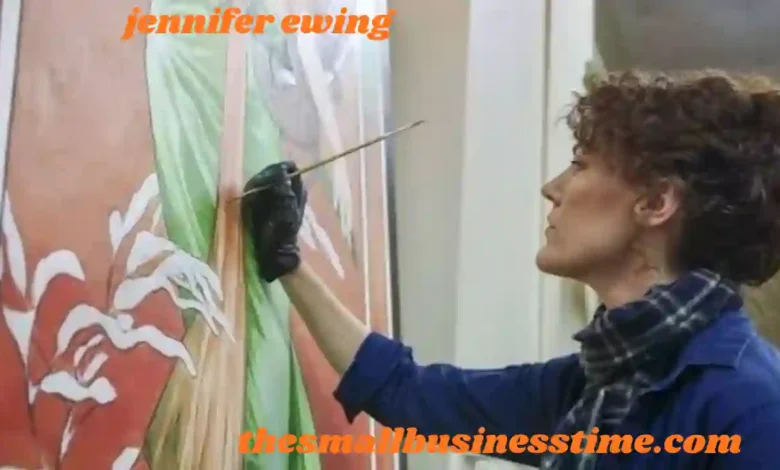
Scenic art is another important dimension of Jennifer Ewing’s career. Scenic artists help transform the physical environment of a stage by painting backdrops, flats, architectural details, decorative elements, and props. Their work contributes to the atmosphere and visual identity of a production.
Ewing entered scenic painting when a friend needed a mural backdrop for a play. The project offered an opportunity to combine her interest in visual art with her connection to the theatre community. What began as a way to contribute between acting projects gradually developed into a more substantial professional activity.
Scenic painting differs from creating a conventional painting for a gallery. A stage design must function within a larger production and remain effective under theatrical lighting, from the audience’s viewing distance, and in combination with costumes, props, and performers.
A scenic artist may need to reproduce a specific material, create the impression of architectural depth, establish the appearance of an aged surface, or paint a large background that supports the production’s setting. These tasks require technical knowledge, careful planning, and an understanding of how visual elements appear under performance conditions.
Scaling up an artistic technique can also present practical challenges. A technique that works on a small sheet of paper may require adjustments when applied to a large theatrical flat. Materials, drying times, lighting conditions, and the physical dimensions of the set can influence the final result.
Ewing developed her scenic-art skills through experience, research, experimentation, and trial and error. Her work eventually expanded to include painting entire sets for professional productions in a scenic-charge capacity.
This career path highlights the value of practical learning in creative industries. Formal education can provide a strong foundation, but many specialized skills develop through repeated application and collaboration with experienced colleagues.
Directing, Producing, Dramaturgy, and Dialect Coaching
Jennifer Ewing’s theatrical work also includes directing, producing, dramaturgy, and dialect coaching. These responsibilities demonstrate the range of expertise required to bring a theatrical production from an initial concept to a finished performance.
A director helps establish the artistic interpretation of a play. This role involves guiding actors, shaping scenes, coordinating creative choices, and maintaining a consistent vision for the production. Directors must consider how individual performances contribute to the overall dramatic structure.
Producers concentrate on the organizational and practical requirements of a production. Depending on the project, their work may involve coordinating schedules, resources, personnel, planning, and communication among the creative team. Producing requires an understanding of both artistic ambitions and the practical conditions under which a production must operate.
Dramaturgy involves examining a play’s text, structure, historical context, themes, and dramatic possibilities. A dramaturg may support a director and cast by researching the world of the play, identifying important questions, and helping the team understand the material more deeply.
Dialect coaching focuses on speech and pronunciation. In theatre, actors may need to adopt a particular accent or speech pattern while maintaining clarity and consistency. A dialect coach can help performers study pronunciation, rhythm, vowel sounds, and other features of spoken language.
These responsibilities may appear separate, but they frequently overlap in practice. A director benefits from understanding the text, a producer needs to appreciate the artistic requirements of the project, and an actor can use research to develop a more convincing character.
Ewing’s involvement in several areas of theatrical production gives her experience with the different processes that contribute to a successful performance. It also reflects the collaborative nature of theatre, where many specialists work together to create an experience that appears unified to an audience.
A Creative Philosophy Centered on Women’s Stories
One of the most distinctive aspects of Jennifer Ewing’s stated artistic interests is her commitment to stories that center women’s voices and experiences. This focus connects her work as a performer with her interests in visual art and storytelling.
Women’s experiences have been represented in theatre and visual art in many different ways throughout history. Some works emphasize public achievements and historical events, while others examine domestic life, relationships, personal identity, aging, creativity, or the emotional realities of everyday experience.
An interest in women-centered storytelling creates room for a broad range of subjects. It does not require every work to communicate the same message or present women in a single way. Instead, it can encourage artists to explore the variety of lives, perspectives, conflicts, and aspirations that shape individual experiences.
In theatre, this approach can influence the selection of plays, the interpretation of characters, and the development of original work. In visual art, it can affect the subjects chosen for portraits, the emotions communicated through an image, and the attention given to details that might otherwise be overlooked.
Ewing’s interest in intimate moments also complements this philosophy. Personal experiences do not always appear significant from the outside, yet they can carry substantial emotional meaning for the people involved. Art can make these moments visible and invite audiences to consider their importance.
A focus on women’s experiences can also create opportunities for collaboration among artists, writers, performers, and audiences. By examining different perspectives, creative work can encourage conversations about identity, memory, relationships, and the ways people understand themselves and one another.
Jennifer Ewing’s Connection with the Seattle Arts Community
Seattle provides an important professional setting for Jennifer Ewing’s work. The city has a varied arts environment that includes theatre companies, independent artists, visual-art organizations, performance venues, and collaborative creative projects.
Regional theatre communities often rely on relationships developed over time. Performers, directors, designers, technicians, and producers may work together across multiple productions, allowing professional connections and shared experience to grow. These relationships can create opportunities for artists to explore different roles and contribute to projects in more than one capacity.
Ewing’s documented association with several Seattle-area theatrical organizations illustrates her participation in this collaborative environment. Her combination of acting and scenic art is especially relevant to regional theatre, where professionals may develop skills across several areas while maintaining a connection with the same artistic community.
Theatre companies need people who can combine specialized expertise with a willingness to work collaboratively. An actor must coordinate with fellow performers, a scenic artist must communicate with designers and production staff, and a producer must help ensure that different parts of the project come together.
Participation in a local arts community can also provide opportunities to develop new work. Independent productions, workshops, staged readings, and collaborative projects allow artists to experiment with ideas that might not fit within more conventional entertainment formats.
For Ewing, working across disciplines offers several ways to contribute to this environment. Her career demonstrates that a professional artist’s influence is not measured solely by celebrity recognition. It can also be understood through sustained participation, practical contributions, and the creative relationships built over time.
Recent Projects and Continued Artistic Development
Jennifer Ewing’s professional activities have continued to include both performance and visual art. Her public updates have documented projects involving theatre, film, and fine-art practice, illustrating an ongoing interest in exploring different forms of creative expression.
One documented project was the short comedy-whodunit On the Record, created for the 48 Hour Film Project. Ewing was cast as Jen in the production, which was developed by Not Like Other Girls Productions and directed by Nolan Anderson. The project received recognition in the 2024 Best of Seattle Awards, including an award for Best Use of Character and a fourth-place result with honorable mention for Best Film.
A short film created within a 48-hour production framework presents a different set of challenges from a stage play. The production team must work under significant time constraints while coordinating writing, filming, editing, scoring, and other technical tasks. Actors need to respond quickly to the creative process and help establish recognizable characters within a limited running time.
Her involvement in this project demonstrates an interest in screen performance alongside her established theatrical work. Film and theatre require some overlapping skills, including character interpretation, collaboration, and an understanding of dramatic structure, but they use different methods to communicate with audiences.
Ewing has also shared information about her fine-art practice and opportunities for people interested in learning about her creative process. This reflects another aspect of a contemporary artist’s professional life: communicating directly with audiences and offering insight into the work behind finished pieces.
The continuation of these activities suggests a career shaped by experimentation rather than a fixed professional identity. Acting, painting, and production work can provide different challenges, allowing an artist to develop new skills while continuing to explore established interests.
What Makes Jennifer Ewing’s Career Distinctive?
Jennifer Ewing’s career stands out because it brings together disciplines that are often treated as separate professional paths. Many artists concentrate on a single specialty, but her work demonstrates how acting, painting, production, and artistic research can inform one another.
Her acting experience offers insight into character, language, and the emotional structure of stories. Her visual-art practice encourages close observation of color, light, shape, and atmosphere. Scenic painting connects these interests by translating artistic ideas into practical environments for live performance.
Her experience in directing, producing, dramaturgy, and dialect coaching adds another layer to this combination. Each responsibility requires a different perspective on how theatre works, from interpreting a text to coordinating the people and practical resources required to present it.
Another distinctive feature is her willingness to learn through practice. Her development as a scenic artist illustrates how professional growth can emerge from a project that initially appears relatively small. By applying existing knowledge, researching unfamiliar techniques, and gaining experience through successive productions, she expanded her creative responsibilities.
Her artistic interests also provide a consistent thread across different forms of work. Stories about women, intimate human experiences, and the natural world offer subjects that can be explored through performance as well as painting.
These connections help explain why a multidisciplinary approach can be rewarding. Rather than dividing creative interests into unrelated activities, an artist can use the skills developed in one area to deepen the work produced in another.
The Importance of Multidisciplinary Artists in Modern Theatre
Modern theatre depends on collaboration among people with different forms of expertise. Actors, directors, designers, painters, technicians, producers, and writers all contribute to a production, and the final result depends on how effectively their efforts are coordinated.
Multidisciplinary artists can offer useful perspectives because they understand more than one part of the creative process. An actor with experience in scenic art may be especially attentive to the physical environment of a scene. A visual artist who understands performance may have a stronger sense of how a design interacts with movement and dramatic timing.
This does not mean that every artist must perform several professional roles. Specialization remains essential, particularly for technically demanding work. However, familiarity with other disciplines can help creative professionals communicate more effectively and appreciate the challenges faced by their collaborators.
Ewing’s career provides an example of this interconnected model. Her activities span the performance itself, the visual environment surrounding it, and the planning and interpretation that support the production.
Such versatility can also help artists adapt to changing opportunities. Theatre projects vary in size, budget, subject, and artistic ambition. A professional with several related skills may find different ways to contribute as the needs of a production evolve.
At the same time, maintaining multiple creative practices requires organization and sustained effort. Acting, painting, and production responsibilities each involve their own schedules, technical requirements, and preparation. Balancing them successfully depends on continued learning and an understanding of the demands associated with each role.
The broader lesson is that a creative career does not need to fit within a single category. Artists can develop individual professional identities by connecting interests, pursuing practical opportunities, and remaining open to new forms of expression.
Public Recognition and Professional Legacy
Jennifer Ewing’s professional work is best understood through her participation in theatre productions, scenic-art projects, and visual-art activities. Although her career does not depend on widespread celebrity recognition, her documented experience demonstrates sustained engagement with creative work.
Recognition in the performing arts can take many forms. A production may receive positive reviews, a film may earn festival recognition, or a performer may become valued by directors and collaborators for reliability, preparation, and creative contribution. In visual art, recognition can come through exhibitions, the development of an individual style, and the relationships built with viewers and other artists.
For a multidisciplinary artist, these forms of recognition may overlap. A successful theatrical project can strengthen professional relationships that lead to future opportunities, while visual-art work can introduce audiences to a different aspect of the artist’s practice.
Ewing’s career also illustrates why a professional biography should consider the work that happens behind the scenes. Scenic painting, dramaturgy, coaching, and producing may be less visible than an actor’s performance, but they are essential parts of the artistic process.
A meaningful assessment of an artist’s contribution should therefore consider both public-facing achievements and the less visible work required to create them. In theatre, the final performance represents the combined effort of many people, each bringing particular knowledge and skills to the project.
Ewing’s varied responsibilities reflect this collaborative reality. Her professional identity is shaped not only by the characters she portrays but also by the artistic environments she helps create and the different ways she contributes to storytelling.
Conclusion
Jennifer Ewing represents a multidisciplinary approach to artistic work, combining theatre performance with fine art, scenic painting, and other production responsibilities. Her education at the American Academy of Dramatic Arts, her participation in regional theatre, and her development as a visual artist provide a foundation for understanding her professional journey.
Her work with theatre organizations, including her participation in A Christmas Carol at A Contemporary Theatre, illustrates the preparation and adaptability required in live performance. Her scenic-art practice demonstrates how visual creativity can become an essential part of theatrical storytelling, while her fine-art interests reveal a continuing appreciation for portraiture, natural forms, light, and intimate human experiences.
Ewing’s involvement in directing, producing, dramaturgy, and dialect coaching further demonstrates the range of skills that can contribute to a successful theatrical career. These responsibilities require different kinds of knowledge, yet they share a common purpose: helping creative ideas become meaningful experiences for audiences.
Her stated interest in women-centered storytelling provides another connecting theme across her work. Through performance and visual art, she explores opportunities to represent personal experiences, emotions, and perspectives in ways that invite reflection.
Ultimately, Jennifer Ewing’s career illustrates the possibilities of remaining curious, developing skills across disciplines, and finding connections between different forms of artistic expression. Her professional journey offers an example of how theatre and visual art can complement one another, allowing creativity to extend beyond a single medium and contribute to a broader artistic practice.
Frequently Asked Questions About Jennifer Ewing
1. Who is Jennifer Ewing?
Jennifer Ewing is a multidisciplinary artist based in Seattle, Washington. She is known for her work as an actress, fine artist, scenic artist, director, producer, dramaturg, and dialect coach.
2. Where did Jennifer Ewing study acting?
Jennifer Ewing studied at the American Academy of Dramatic Arts in New York City, graduating with honors.
3. What is Jennifer Ewing known for in theatre?
She has performed with regional theatre organizations, including Seattle Shakespeare Company, A Contemporary Theatre, ArtsWest, Seattle Public Theatre, and Theatre22. Her experience includes classical, period, and contemporary productions.
4. Is Jennifer Ewing also a visual artist?
Yes. In addition to acting, she works as a fine artist and scenic painter. Her visual-art practice includes soft pastels, portraiture, and subjects inspired by women and the natural world.
5. What makes Jennifer Ewing’s artistic career distinctive?
Her career combines several creative disciplines. By working in acting, visual art, scenic painting, and theatrical production, she brings different perspectives to storytelling and collaborative artistic projects.
ALSO READ : Illai Gescheit: Exploring the Background, Personal Identity, Public Presence, and Story Behind the Name