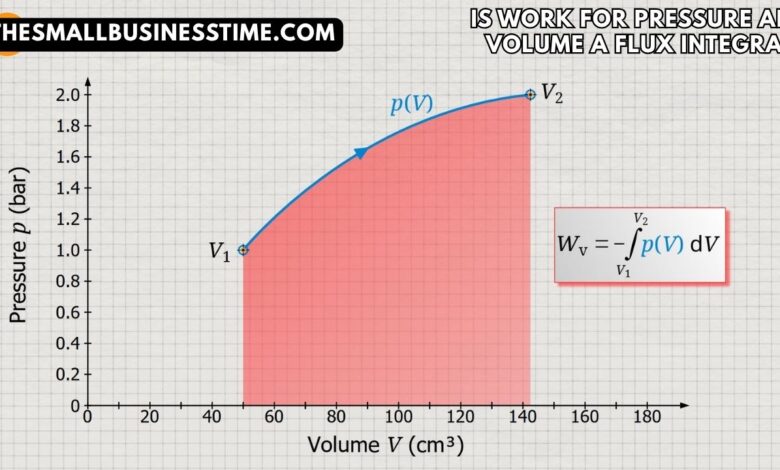
The question “is work for pressure and volume a flux integral” sits at the intersection of thermodynamics, fluid mechanics, and vector calculus. At first glance, pressure-volume work seems like a simple scalar concept taught in basic physics: work equals pressure times change in volume. However, when we move into advanced engineering and physics, especially in fluid systems and control volume analysis, this simple idea transforms into something much deeper.
To answer is work for pressure and volume a flux integral, we must understand both concepts independently. Pressure-volume work arises in thermodynamics when a gas expands or compresses. A flux integral, on the other hand, comes from vector calculus and represents the flow of a vector field through a surface. Surprisingly, these two ideas are strongly connected, but they are not identical in all cases.
This article explores the relationship in depth, showing when pressure-volume work behaves like a flux integral and when it does not.
Pressure-Volume Work in Thermodynamics
In thermodynamics, work done by a system due to volume change is expressed as:
Work = Pressure × Change in Volume (in simple form)
More precisely, for a quasi-static process:
δW = P dV
This expression represents infinitesimal work done when a system expands or compresses under pressure.
In a gas contained in a piston-cylinder system, when the gas expands, it pushes the piston outward. The force arises from pressure acting on the piston surface. Since pressure is force per unit area, the total force becomes:
Force = Pressure × Area
When the piston moves a small distance, work is done:
Work = Force × Distance
This can be rewritten as:
Work = Pressure × Area × Distance
Work = Pressure × Change in Volume
So at a basic level, pressure-volume work is scalar and one-dimensional.
However, this simplicity hides deeper structure.
What is a Flux Integral?
A flux integral measures how much of a vector field passes through a surface. Mathematically, it is written as:
Flux = ∬ F · dA
Where:
F is a vector field (like velocity or force field)
dA is a surface element vector (normal to the surface)
Flux integrals appear in fluid flow, electromagnetism, and transport phenomena.
For example:
In fluid mechanics, flux measures how much fluid passes through a surface.
In electromagnetism, it measures electric or magnetic field passing through a surface.
Flux integrals are inherently geometric and vector-based.
Connecting Pressure to Surface Forces
To understand whether is work for pressure and volume a flux integral, we must reinterpret pressure in vector form.
Pressure acts normal (perpendicular) to surfaces. The force due to pressure on a surface element is:
dF = P n dA
Where:
P is pressure
n is outward unit normal
dA is area element
Work done by pressure forces when the surface moves is:
dW = F · displacement
If the surface moves outward due to expansion, displacement can be expressed as a velocity field.
This begins to resemble a flux structure.
Volume Change as a Geometric Flow
Volume change is not just a scalar increase or decrease; it can be interpreted geometrically as boundary motion.
In advanced fluid mechanics, volume change is related to surface motion:
dV = ∬ (velocity · normal) dA dt
This is already in flux form.
So volume change can be expressed as a surface integral of velocity flux.
This is the key insight: Volume change itself can be written as a flux integral.
Is Pressure-Volume Work a Flux Integral?
Now we return to the main question: is work for pressure and volume a flux integral?
The answer is:
Partially yes, but not directly.
Pressure-volume work can be rewritten in a flux-like form in continuum mechanics:
Work = ∬ P (v · n) dA dt
This resembles a flux integral because:
v · n represents flow across a surface
dA integrates over a boundary surface
pressure acts as a scalar field weighting the flux
So pressure-volume work is related to a weighted flux of motion across a boundary.
However, it is not a pure flux integral of a vector field because:
Pressure is scalar, not vector
Classical flux integrals apply to vector fields
Thus, it is more accurate to say:
Pressure-volume work is a scalar-weighted flux over a moving boundary, not a standard flux integral.
Control Volume Perspective and Fluid Mechanics
In fluid mechanics, we use control volumes to analyze systems where mass and energy flow in and out.
The Reynolds Transport Theorem connects system and control volume descriptions:
It converts system work and energy into surface flux terms.
In this framework, pressure work becomes:
A surface integral over the control boundary
This is where the connection becomes stronger.
In compressible flow systems:
Work is related to pressure forces acting across boundaries
Boundaries define flux of momentum and energy
So in engineering analysis, pressure-volume work naturally transforms into flux integrals.
Why the Confusion Happens
The confusion behind is work for pressure and volume a flux integral comes from overlapping mathematical structures:
Pressure acts on surfaces → surface integrals
Volume change depends on boundary motion → flux-like expression
Work involves force and displacement → energy transfer across boundaries
Because all these involve surfaces and integrals, they appear similar.
But fundamentally:
Work is energy transfer (scalar quantity)
Flux is flow measurement of vector fields
They are mathematically related but conceptually distinct.
Special Case: Ideal Gas Expansion
Consider an ideal gas expanding in a piston:
Work = ∫ P dV
If rewritten in terms of surface motion:
dV = ∬ v · n dA dt
So:
Work = ∬ P (v · n) dA dt
This shows pressure-volume work as a boundary flux integral of energy transfer rate.
In this special case: ✔ It behaves like a flux integral ✔ It is expressed over a surface ✔ It depends on normal velocity flow
So in thermodynamic systems with moving boundaries, the answer becomes closer to “yes.”
When Pressure-Volume Work is NOT a Flux Integral
Pressure-volume work is NOT a flux integral when:
The process is purely scalar and quasi-static
Volume change is treated without boundary formulation
Thermodynamics is used in simplified 1D form
No spatial vector field representation is involved
In introductory physics:
W = PΔV is not treated as flux
No surface integrals are used
Thus, the flux interpretation only appears in advanced formulations.
Physical Interpretation of the Relationship
The deeper meaning of is work for pressure and volume a flux integral lies in energy transfer through boundaries:
Pressure represents intensity of force on boundaries
Volume change represents motion of those boundaries
Work represents energy crossing system boundaries
Flux integrals also represent quantities crossing boundaries.
So both describe:
Transfer through a surface over time
This is why they are mathematically linked.
Final Conceptual Answer
To summarize:
Pressure-volume work is not inherently a flux integral
But it can be expressed as a flux integral in continuum mechanics
The connection appears in control volume and fluid flow analysis
It becomes exact when using surface velocity representation
So the best answer is:
Pressure-volume work is not strictly a flux integral, but in advanced thermodynamics and fluid mechanics it can be reformulated as a surface flux of pressure-weighted boundary motion.
Conclusion
The question is work for pressure and volume a flux integral reveals the deep unity between thermodynamics and vector calculus. While basic physics treats pressure-volume work as a simple scalar product, advanced physics shows that it emerges from boundary flux interactions.
When systems are analyzed using control volumes, moving surfaces, and vector fields, pressure-volume work naturally transforms into flux-like integrals. However, it remains fundamentally an energy transfer quantity rather than a pure flux definition.
This dual nature is what makes the concept both mathematically rich and physically powerful.