Jyokyo Meaning, Context, Culture, and Everyday Usage
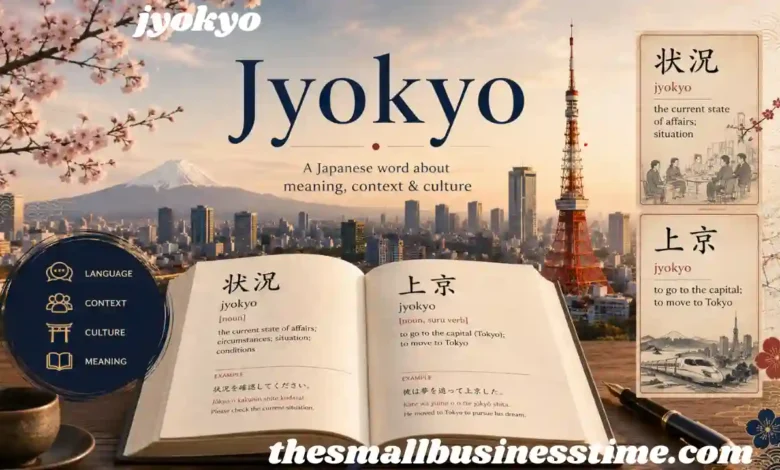
The word jyokyo may appear simple when written in English letters, but its meaning becomes much more interesting when viewed through the Japanese language. Depending on the Japanese characters being represented, jyokyo can refer to a situation or set of circumstances, while a similarly pronounced word can describe going to the capital, particularly Tokyo. This makes jyokyo a useful example of why context matters so much when understanding Japanese vocabulary. Japanese words written in Roman letters sometimes lose information that would normally be immediately clear from their kanji.
One of the most relevant meanings associated with jyokyo is the Japanese word 状況, generally romanized as jōkyō or joukyou. It means a situation, circumstances, condition, or state of affairs. The same pronunciation can also correspond to 上京, a word referring to going to the capital and, in modern Japanese usage, commonly going or moving to Tokyo. Because the exact spelling “jyokyo” does not show the kanji, readers must rely on the surrounding conversation to understand which meaning is intended.
For people encountering jyokyo for the first time, the most useful approach is therefore not to search for a single rigid English translation. Instead, it helps to understand how the concept of a “situation” works in everyday communication, decision-making, personal relationships, workplaces, and Japanese cultural settings. Doing so reveals that jyokyo can represent much more than a dictionary definition. It can describe everything surrounding an event at a particular moment.
What Does Jyokyo Mean?
In its widely useful sense, jyokyo refers to a situation, circumstances, condition, or current state of affairs. A person might use it when discussing what is happening at work, describing the condition of a project, explaining a family matter, reporting an emergency, or asking about the progress of something.
The English word “situation” is a good starting point, but jyokyo can sometimes carry a wider range of meanings depending on the sentence. It may indicate the present condition of something, the circumstances surrounding an event, or the overall environment in which decisions have to be made.
For example, someone discussing a delayed project could talk about the current jyokyo. In that case, the word could mean the project’s present status or circumstances. Someone describing difficult weather conditions could similarly refer to the jyokyo surrounding travel. In another conversation, it could concern economic conditions, family circumstances, health-related circumstances, or social developments.
This flexibility makes jyokyo useful because situations are rarely defined by one detail. A situation may involve people, timing, environment, available information, expectations, risks, and previous events. Jyokyo can therefore serve as a broad word covering several connected circumstances at once.
Why Context Is Important When Understanding Jyokyo
Japanese communication often depends heavily on context. This is particularly noticeable with words that have several possible interpretations. Jyokyo demonstrates this clearly because the Roman-letter spelling does not tell a reader exactly which Japanese characters were originally intended.
When jyokyo represents 状況, the conversation will usually involve conditions, circumstances, progress, or the state of something. When a similar pronunciation represents 上京, the topic will normally involve traveling or relocating to Japan’s capital. Dictionaries describe 上京 as going to the capital or going to Tokyo.
Consider how naturally context resolves the difference. A conversation about a company’s financial difficulties would probably use jyokyo in the sense of circumstances or conditions. A conversation about a university graduate leaving a hometown to begin work in Tokyo could involve the meaning of going to the capital.
This distinction demonstrates an important feature of Japanese. Pronunciation alone does not always contain enough information to determine meaning. Kanji and surrounding language help identify exactly what the speaker or writer intends.
Jyokyo as a Situation or State of Affairs
Understanding jyokyo as “situation” opens the door to many practical uses. People constantly evaluate situations in ordinary life. They consider what is happening, who is involved, what resources are available, and what should happen next.
A business manager, for example, may need to understand the current jyokyo before changing a project schedule. A student may consider the jyokyo surrounding an examination before deciding how much additional preparation is necessary. A family could evaluate its financial jyokyo before making a major purchase.
In each case, the term does not necessarily describe one isolated fact. It represents a collection of factors forming the current circumstances.
This broader interpretation explains why translating jyokyo simply as “status” can sometimes be too narrow. Status often describes a specific stage or condition. Jyokyo may include the circumstances surrounding that condition as well.
If a train is delayed, its status might simply be “delayed.” The overall jyokyo, however, could include bad weather, crowded stations, alternative transportation, expected recovery time, and the number of affected passengers. In this sense, jyokyo provides a fuller picture.
Jyokyo and Awareness of Surroundings
Another useful way to understand jyokyo is through awareness. People frequently make better choices when they understand the situation around them rather than concentrating only on their immediate goals.
Imagine a person entering a formal meeting. Before speaking, that individual may notice who is present, what has already been discussed, whether the atmosphere is serious or relaxed, and what expectations exist. All of these factors contribute to the situation.
Similarly, someone joining a social gathering may adjust conversation depending on the people present and the mood of the group. This does not mean people must constantly suppress their personalities. Instead, it reflects the ordinary human skill of recognizing circumstances before deciding how to respond.
The concept is not uniquely Japanese. People everywhere interpret their surroundings. However, jyokyo provides a convenient linguistic framework for thinking about the combination of factors that creates a particular moment.
The Role of Jyokyo in Communication
Communication does not happen in isolation. The same sentence may feel appropriate in one jyokyo and uncomfortable in another.
People naturally change their language according to circumstances. They may speak differently to friends than to managers. They may use a more formal tone during a business meeting and a relaxed tone at dinner with relatives. They may avoid jokes during a serious event but welcome humor during a casual celebration.
Understanding jyokyo therefore helps explain why effective communication requires more than knowing vocabulary.
The listener, relationship, setting, timing, and purpose of a conversation all influence how words are understood. An effective communicator recognizes these conditions.
This principle is especially useful for language learners. Memorizing words and grammar provides the foundation, but understanding when particular expressions are appropriate is equally important. Jyokyo reminds learners that language exists within real social situations.
Jyokyo in Japanese Workplaces
Workplaces provide many examples of how situations influence behavior.
An employee facing a problem must often consider several factors before responding. How urgent is the issue? Who needs to know about it? Can it be solved independently? Does it affect customers? Could it delay another team’s work? Has a manager already provided instructions?
Together, these details form the jyokyo surrounding the problem.
A skilled employee does not merely react to the first piece of information. That person tries to understand the circumstances before deciding what action makes sense.
The same principle applies to meetings. Participants may need to understand the background of a proposal, available resources, deadlines, customer expectations, and possible risks. A proposal that looks excellent on paper might be unrealistic under the current jyokyo.
For this reason, situational understanding can become an important professional skill. It supports judgment, communication, cooperation, planning, and problem-solving.
Jyokyo and Personal Relationships
Personal relationships are also strongly influenced by circumstances.
Suppose a friend unexpectedly cancels a meeting. Without understanding the jyokyo, another person might immediately assume the cancellation shows a lack of interest. Yet the circumstances could involve illness, family responsibilities, transportation difficulties, or an urgent work problem.
Understanding the situation encourages a more complete interpretation.
The same principle matters during disagreements. Arguments often become more intense when people react only to individual statements while ignoring the broader circumstances. Stress, misunderstandings, previous experiences, timing, and emotional pressure can all affect communication.
Thinking about jyokyo can encourage people to ask a useful question: What else is happening here?
That question can reveal information that changes how an event is understood.
It does not mean that every action should be excused because of circumstances. Instead, it means circumstances should be considered before conclusions are reached.
Jyokyo and Decision-Making
Good decisions depend on accurate information about the current situation.
Before making an important decision, people usually evaluate several elements: objectives, risks, alternatives, timing, available resources, possible consequences, and the needs of others.
Together, these elements form the decision-making jyokyo.
For example, someone considering a new job may look beyond salary. Location, career opportunities, working hours, housing costs, family responsibilities, company culture, and long-term goals may all influence the decision.
A decision that looks attractive under one set of circumstances could be less attractive under another.
This illustrates why jyokyo is such a practical idea. It emphasizes that decisions are rarely universally correct or incorrect without context.
Jyokyo in Unexpected Events
The importance of understanding a situation becomes especially clear during unexpected events.
Emergencies, transportation disruptions, severe weather, technical failures, and sudden changes require people to gather information quickly.
During these moments, understanding the jyokyo can prevent unnecessary confusion.
A person dealing with a delayed flight, for instance, may need information about departure times, alternative flights, accommodation, baggage, connecting transportation, and weather conditions. The complete situation matters more than any individual detail.
Similarly, organizations responding to disruptions need to establish what happened, what is currently affected, what risks remain, and what resources are available.
Accurate situational awareness makes coordinated action possible.
Jyokyo in News and Public Information
The idea of jyokyo is also useful when reading news.
A headline presents a small part of an event, but the full situation often includes historical background, competing interests, economic conditions, social factors, geography, timing, and multiple perspectives.
Readers who want to understand an event more deeply therefore look for its surrounding circumstances.
This does not mean every story has an endlessly complicated explanation. It simply means that events usually make more sense when placed in context.
Understanding jyokyo can encourage readers to distinguish between a single development and the broader state of affairs.
For example, one economic statistic provides useful information, but it may not fully describe the economic jyokyo. Employment, consumer confidence, inflation, business investment, wages, and other factors could also contribute to the overall picture.
Jyokyo and Adaptability
Situations change, sometimes very quickly.
Because of this, understanding jyokyo is closely connected to adaptability. A plan that made sense yesterday may need adjustment today because circumstances have changed.
Businesses experience this constantly. Customer demand changes, supplies become unavailable, deadlines move, competitors introduce new products, and technology evolves.
Families experience it as well. Schedules change, expenses appear unexpectedly, children grow older, jobs change, and priorities shift.
Adaptability means recognizing these changes and responding appropriately rather than following an outdated plan simply because it was previously established.
Jyokyo provides a useful way of thinking about that process. First, a person observes the current circumstances. Then those circumstances can be compared with expectations. Finally, behavior or plans can be adjusted if necessary.
Jyokyo and Social Expectations
Every community develops expectations about behavior.
People learn that certain environments call for different kinds of conduct. A classroom, funeral, wedding, sporting event, business conference, and family dinner each create different social circumstances.
Understanding jyokyo helps people recognize these differences.
Someone might speak enthusiastically and loudly at a sports celebration but behave quietly at a memorial event. The personality has not necessarily changed. The person has simply responded to the setting.
Social intelligence often involves this ability to recognize what a particular situation requires.
At the same time, situational awareness should not be confused with automatically following every expectation. People can question customs and make independent decisions while still understanding the context surrounding those decisions.
Another Meaning of Jyokyo: Going to Tokyo
A second important meaning must be mentioned because Romanized Japanese can create confusion.
The Japanese term 上京, usually written as jōkyō or joukyou, refers to going to the capital and in modern usage commonly describes going to or moving to Tokyo.
The characters themselves help explain the idea. 上 can carry a sense of “up,” while 京 means “capital.” Together, they form a word associated with going up to the capital.
Someone from another part of Japan who relocates to Tokyo for university, employment, entertainment work, or another opportunity may be described using this term.
This meaning is very different from 状況, which refers to a situation or circumstances. Yet their readings can look very similar when represented in English letters.
That is why the exact kanji matters.
Jyokyo and Moving to the Capital
The idea of moving to Tokyo carries its own social and personal significance.
For many people, moving from a smaller city or rural region to a major metropolitan area represents a major life transition. It can involve leaving family, finding housing, beginning university, entering a new workplace, building friendships, and adapting to a faster urban lifestyle.
Tokyo offers enormous educational, professional, cultural, and entertainment opportunities. At the same time, relocating to such a large city can involve practical challenges such as commuting, housing expenses, unfamiliar neighborhoods, and separation from established support networks.
In this meaning, jyokyo can therefore appear in stories about ambition, independence, education, employment, or personal change.
A young person may move to Tokyo to pursue a career. A musician may relocate because the entertainment industry offers more opportunities there. A university student may leave a hometown to attend a school in the capital.
Each journey has different motivations, but the movement toward the capital connects them.
Why Jyokyo Can Be Confusing Online
The spelling jyokyo can create confusion because Japanese romanization is not completely uniform in informal English-language writing.
The long vowel in jōkyō may be represented using a macron, doubled vowels, or simplified spellings. As a result, readers may encounter forms such as jōkyō, joukyou, jokyo, or jyokyo.
This becomes even more complicated when different Japanese words share similar pronunciations.
When kanji are available, the difference is straightforward:
状況 relates to a situation, circumstances, or state of affairs.
上京 relates to going to the capital or Tokyo.
When only jyokyo appears, surrounding words become essential.
A useful rule is to examine what the sentence is discussing. If it concerns conditions, circumstances, progress, or what is currently happening, the intended meaning is likely “situation.” If it concerns travel, relocation, or Tokyo, the capital-related meaning is more likely.
How Language Learners Can Understand Jyokyo
For Japanese learners, jyokyo offers a useful lesson about studying vocabulary.
Words should not always be memorized as simple one-to-one translations.
Learning that jyokyo means “situation” is useful, but understanding examples makes the word easier to remember. Learners can connect it with questions about current conditions, workplace circumstances, social situations, and changing events.
It also helps to learn vocabulary together with its kanji.
Kanji often provides information that pronunciation alone cannot communicate. Two words may sound similar while having completely different meanings.
Studying sentences rather than isolated words can also improve understanding. A learner who sees jyokyo used in multiple contexts begins to recognize naturally where the word belongs.
This approach turns vocabulary learning into understanding rather than simple memorization.
Jyokyo in Everyday Problem-Solving
The concept of jyokyo can even be applied outside language study.
When a problem appears, people often benefit from defining the current situation before searching for a solution.
A useful process might involve identifying what has happened, what is known, what remains uncertain, who is affected, what resources are available, what limitations exist, and what outcome is desired.
Once the jyokyo becomes clearer, possible solutions often become clearer as well.
Imagine a family trying to reduce monthly expenses. Simply deciding to “spend less” may not solve the problem. Understanding the situation requires reviewing income, fixed bills, debt, transportation expenses, food costs, subscriptions, and discretionary spending.
The clearer the situation becomes, the easier it is to make targeted decisions.
The same reasoning works for business problems, study challenges, travel difficulties, and personal projects.
Jyokyo and Technology
Modern technology has made situational information more accessible than ever.
People can instantly check traffic conditions, weather forecasts, transportation schedules, financial information, project dashboards, messages, and breaking developments.
These tools help users understand the current jyokyo before making decisions.
A driver can check road conditions before choosing a route. A traveler can check train delays. A business team can review project information before a meeting. A shopper can compare availability before visiting a store.
However, having more information does not automatically create better understanding.
People still need to determine which information is reliable, relevant, and current. Too much information can sometimes make a situation harder to understand rather than easier.
Modern situational awareness therefore involves both gathering information and filtering it intelligently.
Jyokyo and Cultural Understanding
Learning a language often provides insight into how people organize ideas.
Jyokyo is valuable in this respect because it encourages learners to pay attention to circumstances rather than looking only at isolated statements or actions.
When encountering unfamiliar behavior in another country, people may initially interpret it using expectations from their own culture. Understanding the local situation can provide a more accurate explanation.
What is considered polite, direct, casual, formal, respectful, or inappropriate can vary between environments.
Recognizing jyokyo means looking at who is involved, where the interaction occurs, what relationship exists between participants, and what expectations surround the event.
This approach can make cross-cultural communication more thoughtful.
Common Misunderstandings About Jyokyo
One misunderstanding is assuming that jyokyo has only one possible English translation. Depending on the context, “situation,” “circumstances,” “conditions,” or “state of affairs” may all be appropriate.
Another mistake is assuming that every appearance of the Romanized spelling represents the same Japanese word. Because several Japanese terms can sound similar, identifying the kanji is important.
A third misunderstanding is treating jyokyo as an abstract philosophical concept in every case. Although people may use the idea of situational awareness to discuss culture and behavior, the Japanese word 状況 is also ordinary vocabulary used in everyday practical situations.
Someone asking about a project’s jyokyo may simply want to know how the project is going.
Someone describing a difficult jyokyo may simply mean difficult circumstances.
Understanding these ordinary uses prevents the term from becoming unnecessarily mysterious.
Why Jyokyo Remains a Useful Word to Know
Jyokyo is useful because people constantly discuss situations.
They ask about current conditions, describe circumstances, evaluate changes, explain problems, and make decisions based on what is happening around them.
The concept appears naturally in professional environments, personal conversations, public information, travel, education, technology, and everyday problem-solving.
For Japanese learners, it also provides an excellent example of how context, kanji, pronunciation, and Romanization work together.
Seeing jyokyo written in English letters may appear straightforward at first. Once its possible Japanese forms are considered, however, the word becomes a useful lesson in linguistic context.
Jyokyo in a Changing World
The modern world changes quickly. Technology, employment, communication, transportation, education, and social expectations continue to evolve.
People therefore need to reassess circumstances regularly.
Understanding the current jyokyo before acting can help individuals avoid decisions based on outdated assumptions.
A company may need to reconsider a business strategy because customer behavior has changed. A student may adjust a study plan because an examination schedule has shifted. A family may alter travel arrangements because weather conditions have become unfavorable.
In each example, situational awareness allows people to respond to reality rather than expectations.
This may be one of the most practical lessons connected with jyokyo: circumstances matter.
Frequently Asked Questions About Jyokyo
What is jyokyo?
Jyokyo is a Romanized spelling that can represent Japanese words with similar pronunciations. One important form, 状況, means a situation, circumstances, condition, or state of affairs. Another, 上京, relates to going to the capital, particularly Tokyo.
Does jyokyo mean situation?
Yes. When jyokyo represents 状況, “situation” is one of its most common and useful English translations. Depending on context, it may also be translated as circumstances, conditions, or state of affairs.
Does jyokyo mean moving to Tokyo?
It can. When the intended Japanese word is 上京, it means going to the capital and commonly refers to going or relocating to Tokyo in modern Japanese usage.
Why does jyokyo have different meanings?
Japanese contains words that share similar pronunciations but use different kanji. When Japanese is converted into Roman letters, those distinctions can become less obvious.
How can someone identify the correct meaning?
The surrounding sentence usually makes the intended meaning clear. Discussions about circumstances or conditions generally indicate 状況, while conversations about moving or traveling to Tokyo point toward 上京.
Is jyokyo commonly connected with context?
When it means 状況, jyokyo is strongly connected with circumstances and the state surrounding an event. “Context” can sometimes help explain the concept, although “situation” or “circumstances” are usually more direct translations.
Why is jyokyo useful for Japanese learners?
It teaches learners not to depend solely on Romanized spelling. Understanding kanji, sentences, and context makes it easier to distinguish words with similar pronunciation.
Final Thoughts on Jyokyo
Jyokyo is a small word with a surprisingly broad story. In the sense of 状況, it helps describe a situation, circumstances, conditions, or the state of affairs surrounding an event. It can be applied to workplaces, relationships, travel, education, public events, problem-solving, and countless moments of everyday life.
The concept also highlights the importance of context. People rarely make decisions based on a single fact. They consider timing, surroundings, relationships, available information, risks, and changing conditions. Understanding the jyokyo means seeing these elements together and recognizing how they influence what happens next.
At the same time, readers should remember that a similar Japanese pronunciation can represent 上京, meaning going to the capital or, in modern usage, going to Tokyo. The difference becomes clear when the original kanji or surrounding conversation is available.
For anyone learning about Japanese language and culture, jyokyo therefore offers two lessons at once. The first is linguistic: pronunciation alone may not reveal the complete meaning of a Japanese word. The second is practical: understanding circumstances can lead to clearer communication and better decisions.
Whether someone encounters jyokyo while learning Japanese, reading about Japanese society, discussing a current situation, or exploring the language used around moving to Tokyo, context remains the key. Once that context is understood, the meaning becomes much easier to recognize.
ALSO READ : Meet Nala Cat: The Instagram Star With a Ton of Fo – Tymoff and Her Remarkable Journey