Apparatus Dew Point – Meaning, Calculation, Measurement, HVAC Applications, and Importance
Introduction to Apparatus Dew Point
Apparatus dew point is an important concept in air-conditioning, HVAC design, psychrometrics, and air-treatment systems. It describes the effective temperature at which moisture is considered to be removed from moist air when the air passes over a cooling coil or another dehumidifying surface. Although the term may initially sound similar to ordinary dew point temperature, apparatus dew point has a specific engineering meaning and is particularly useful when analyzing cooling and dehumidification processes.
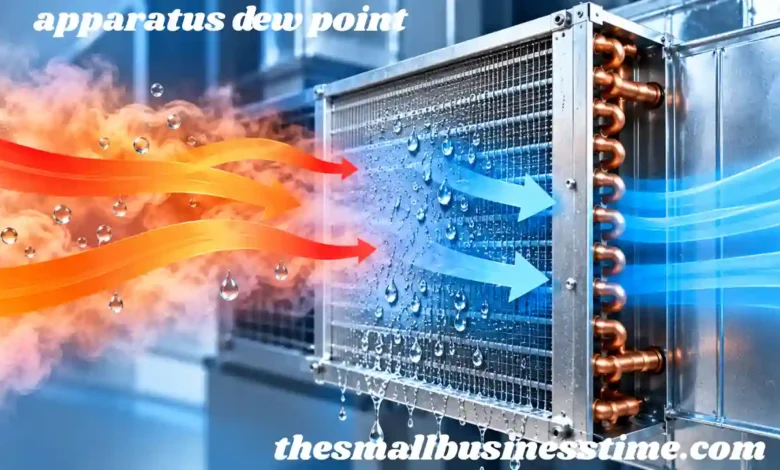
When warm, moist air enters an air-conditioning cooling coil, the coil surface is normally maintained at a temperature below the entering air’s dew point. As the air passes across the coil, it is cooled. Once the air temperature falls below the dew point, some of the water vapor contained in the air begins to condense on the coil surface. The actual air leaving the coil is not normally cooled all the way to the coil’s surface temperature because a portion of the air effectively bypasses the cooling surface. Apparatus dew point provides a convenient way to represent the effective coil temperature associated with this cooling and dehumidification process.
Understanding apparatus dew point is essential for engineers, HVAC technicians, building designers, energy analysts, and students studying psychrometrics. It helps explain how sensible cooling and latent cooling occur together, how cooling coils remove moisture, and why the leaving-air condition depends on factors such as coil temperature, bypass factor, airflow, and entering-air humidity.
The concept becomes particularly important in applications where humidity control is just as important as temperature control. Offices, hospitals, laboratories, manufacturing facilities, data centers, food-processing plants, museums, and many other buildings require careful control of both temperature and moisture. A system that lowers temperature effectively but fails to remove sufficient moisture can still produce an uncomfortable or unsuitable indoor environment. Apparatus dew point therefore provides a useful engineering reference for evaluating dehumidification performance.
What Is Apparatus Dew Point?
Apparatus dew point is the hypothetical temperature at which the cooling and dehumidification process of air over a coil is represented as if the air were brought into contact with a saturated surface at a single effective temperature. In practical HVAC analysis, this effective temperature is associated with the cooling coil and is commonly determined from the entering-air condition and leaving-air condition.
The apparatus dew point is generally lower than the leaving dry-bulb temperature when the cooling coil has a bypass factor greater than zero. The leaving air approaches the apparatus dew point depending on how effectively the coil transfers heat and removes moisture from the air stream.
The term “apparatus” distinguishes this value from the ordinary atmospheric dew point. Atmospheric dew point refers to the temperature at which moisture in air begins to condense under a particular pressure and moisture condition. Apparatus dew point, on the other hand, is an engineering concept used to represent the effective temperature of a cooling or dehumidifying apparatus.
This distinction is important. Two air streams may have different atmospheric dew points, while an HVAC cooling coil can have a particular apparatus dew point based on its operating conditions. Apparatus dew point is therefore not simply another name for the ordinary dew point of the air entering or leaving a system.
In psychrometric analysis, the apparatus dew point is often located on the saturation curve of a psychrometric chart. A straight process line is drawn between the entering-air state and the leaving-air state. If this line is extended until it intersects the saturation curve, the intersection represents the apparatus dew point condition.
Apparatus Dew Point and the Cooling Coil Process
A cooling coil performs two major functions when it operates below the entering-air dew point: sensible cooling and latent cooling. Sensible cooling reduces the dry-bulb temperature of the air, while latent cooling removes water vapor through condensation.
Suppose warm and humid air enters a cooling coil. Initially, the air temperature decreases while its moisture content may remain nearly constant. However, once the air reaches a temperature at which condensation begins, moisture starts collecting on the coil surface. From this point onward, both temperature and humidity ratio decrease.
The coil therefore produces a combined cooling and dehumidification process. The apparatus dew point is used to simplify the analysis of this process. Instead of modeling every small section of the coil, engineers can represent the overall process by assuming that the air moves toward an effective saturated-air condition corresponding to the apparatus dew point.
The actual leaving air does not usually reach this saturation condition. Instead, the leaving-air state lies between the entering-air state and the apparatus dew point. The distance between the leaving-air condition and the apparatus dew point is related to the coil’s bypass factor.
This is one of the reasons apparatus dew point is so useful. It allows engineers to analyze a real cooling coil using a relatively simple psychrometric model while still accounting for the fact that not all air makes perfect contact with the cooling surface.
Apparatus Dew Point vs. Ordinary Dew Point
The difference between ordinary dew point and apparatus dew point is one of the most important points to understand.
The dew point temperature of air is the temperature at which the air becomes saturated with water vapor when it is cooled at constant pressure without changing its moisture content. If the air is cooled below this temperature, condensation begins.
The apparatus dew point, however, is a hypothetical or effective temperature associated with an air-conditioning apparatus, especially a cooling coil. It represents the effective saturated surface temperature toward which the air condition moves during cooling and dehumidification.
For example, if humid air enters a cooling coil with a dry-bulb temperature significantly above the coil’s effective surface temperature, the air can be cooled and dehumidified as it passes through the coil. The apparatus dew point can be found by extending the entering-to-leaving air process line to the saturation curve.
Thus, ordinary dew point describes an air condition, while apparatus dew point is primarily used to describe a cooling/dehumidification process.
How Apparatus Dew Point Is Determined
Apparatus dew point can be determined using a psychrometric chart when the entering and leaving conditions of the cooling coil are known.
First, the entering-air dry-bulb temperature and humidity condition are identified on the psychrometric chart. The leaving-air condition is then plotted using the known leaving dry-bulb temperature and either relative humidity, wet-bulb temperature, humidity ratio, or another suitable property.
A straight line is drawn between the entering-air and leaving-air conditions. This line represents the approximate cooling and dehumidification process through the coil. The process line is extended beyond the leaving-air condition until it reaches the saturation curve.
The temperature corresponding to that intersection is the apparatus dew point.
This graphical approach is particularly useful in HVAC education because it provides a visual representation of the relationship between the entering air, leaving air, and effective coil condition. Modern calculations can also determine apparatus dew point numerically using psychrometric equations and property data.
Apparatus Dew Point Formula
The apparatus dew point can be calculated using the humidity ratio and dry-bulb temperatures of the entering and leaving air.
A common relationship is based on the straight-line approximation between the entering-air condition, leaving-air condition, and saturated apparatus dew point condition:
\frac{T_1-T_2}{T_1-T_{ADP}}
]
where:
- (W_1) = entering-air humidity ratio
- (W_2) = leaving-air humidity ratio
- (W_{ADP}) = humidity ratio at the apparatus dew point
- (T_1) = entering-air dry-bulb temperature
- (T_2) = leaving-air dry-bulb temperature
- (T_{ADP}) = apparatus dew point temperature
The apparatus dew point condition is assumed to be saturated, so the humidity ratio at that temperature can be obtained from psychrometric relationships or a suitable saturation-pressure table.
Another useful relationship connects apparatus dew point with the bypass factor:
[
BF=\frac{T_2-T_{ADP}}{T_1-T_{ADP}}
]
The same relationship can be expressed using humidity ratio:
[
BF=\frac{W_2-W_{ADP}}{W_1-W_{ADP}}
]
These equations show why apparatus dew point and bypass factor are closely connected.
What Is Bypass Factor?
Bypass factor is the fraction of air that is considered to pass through the cooling coil without reaching the effective coil surface condition. It does not necessarily mean that a literal portion of air completely avoids the coil. Rather, it is an engineering representation of imperfect heat and mass transfer.
A cooling coil may have a large surface area, but real airflow does not interact perfectly with every part of the surface. Air velocity, fin geometry, coil depth, surface condition, airflow distribution, and other factors affect the actual heat-transfer process.
The bypass factor is therefore useful for representing the difference between ideal coil performance and actual performance.
A low bypass factor generally indicates that the leaving air condition approaches the apparatus dew point more closely. A higher bypass factor means that the leaving air remains farther from the apparatus dew point.
Coil design aims to achieve appropriate heat and moisture transfer while balancing pressure drop, energy consumption, equipment size, and operating cost.
Relationship Between Apparatus Dew Point and Relative Humidity
Relative humidity plays an important role in cooling and dehumidification, but apparatus dew point should not be confused with relative humidity.
Relative humidity describes how close air is to saturation at a particular temperature. Warm air can contain substantially more moisture than cold air before reaching saturation. Consequently, cooling humid air can cause relative humidity to rise even before condensation begins.
Once the air temperature reaches its dew point, further cooling results in condensation if the process allows moisture to be removed. In a cooling coil, this moisture removal is a major part of the latent cooling load.
The apparatus dew point represents the effective saturated condition associated with the coil process. It can therefore help explain why a cooling coil operating at a low effective temperature can provide substantial dehumidification.
For applications requiring low indoor humidity, the cooling coil’s apparatus dew point becomes particularly important. A coil with an effective temperature that is too high may reduce air temperature without removing enough moisture.
Apparatus Dew Point on a Psychrometric Chart
The psychrometric chart is one of the most useful tools for understanding apparatus dew point.
On a typical psychrometric chart, dry-bulb temperature is represented along the horizontal axis, while humidity ratio is shown vertically. The saturation curve forms the upper curved boundary of the chart.
The entering-air condition is plotted first. The leaving-air condition is then plotted based on its known properties. A straight line between these two conditions represents the approximate coil process.
When this line is extended until it intersects the saturation curve, the intersection provides the apparatus dew point.
This graphical method also shows how the air condition changes through the cooling coil. The horizontal movement associated with temperature reduction represents sensible cooling, while the downward movement associated with decreasing humidity ratio represents moisture removal.
The greater the latent component of the process, the more significant the reduction in humidity ratio becomes. This makes the psychrometric chart an excellent way to visualize the relationship between apparatus dew point, coil performance, and total cooling.
Sensible Cooling and Latent Cooling
Air-conditioning loads are often divided into sensible and latent components.
Sensible cooling is the energy required to reduce the temperature of the air without changing its moisture content. Latent cooling is the energy associated with removing moisture from the air.
When a cooling coil operates above the entering-air dew point, it may provide primarily sensible cooling. However, when the coil surface temperature falls below the air’s dew point, condensation can occur and latent cooling becomes part of the process.
Apparatus dew point is especially relevant to this combined process because it represents the effective saturated endpoint toward which the air moves.
The total cooling capacity of a coil therefore depends not only on how much the dry-bulb temperature falls but also on how much moisture is removed. This is why evaluating an HVAC system only by temperature reduction can provide an incomplete picture of performance.
Importance of Apparatus Dew Point in HVAC Design
Apparatus dew point is an important design parameter for HVAC engineers because it helps determine whether a cooling coil can achieve the required leaving-air condition.
When designing an air-conditioning system, engineers must consider the indoor temperature and humidity requirements, outdoor conditions, airflow rate, cooling load, coil configuration, chilled-water temperature, refrigerant conditions, and desired supply-air state.
A suitable apparatus dew point helps establish whether the coil can provide sufficient sensible and latent cooling.
For example, a building located in a hot and humid climate may require significant dehumidification. If the cooling coil is selected primarily for sensible temperature reduction without considering moisture removal, indoor humidity can remain excessive.
By analyzing the apparatus dew point and bypass factor, engineers can better estimate the leaving-air condition and determine whether additional dehumidification or coil capacity is necessary.
Apparatus Dew Point in Air-Conditioning Systems
In conventional air-conditioning systems, return air and outdoor air may be mixed before entering the cooling coil. The mixed air condition is then cooled and dehumidified as it passes across the coil.
The apparatus dew point can be used to represent the effective coil condition during this process. By knowing the entering and leaving conditions, engineers can determine the coil process and estimate moisture removal.
After leaving the coil, the conditioned air may be reheated before being supplied to the occupied space. Reheating can be useful when the system needs to remove moisture aggressively but does not want to deliver excessively cold air to occupants.
This approach demonstrates why apparatus dew point is especially important in humidity-sensitive applications. The coil may need to operate at a relatively low effective temperature to remove moisture, while the final supply-air temperature may need to be higher for comfort.
Apparatus Dew Point and Chilled-Water Coils
Chilled-water cooling coils are widely used in commercial HVAC systems. Cold water circulates through tubes while air passes across the coil surface.
The chilled-water temperature affects the coil surface temperature and consequently influences the apparatus dew point. Colder chilled water can generally support a lower effective coil temperature, although actual performance depends on coil construction, airflow, water flow, and heat-transfer characteristics.
If the coil temperature is below the entering-air dew point, condensation forms on the coil. This removes moisture from the air stream.
Coil selection therefore involves balancing water temperature, airflow, coil face area, number of rows, fin spacing, pressure drop, and desired leaving-air condition. Apparatus dew point provides a useful conceptual bridge between these physical design factors and the psychrometric analysis.
Apparatus Dew Point and Refrigeration Systems
Direct-expansion refrigeration systems also rely on cooling coils to reduce air temperature and, when appropriate, remove moisture.
Refrigerant flowing through the evaporator absorbs heat from the air. If the evaporator surface temperature falls below the air dew point, moisture condenses on the coil.
The apparatus dew point can help describe the effective thermal condition of the evaporator coil. In practical system analysis, engineers consider refrigerant temperature, evaporator pressure, superheat, airflow, coil construction, and surface temperature distribution.
Although apparatus dew point is a simplified engineering concept rather than a direct measurement of every point on a coil, it remains valuable for evaluating the overall cooling and dehumidification process.
Why Apparatus Dew Point Matters in Humid Climates
Humidity control is especially challenging in hot and humid climates. Outdoor air can contain a large amount of water vapor, and ventilation requirements can introduce substantial latent loads into buildings.
A cooling system may reach the desired indoor temperature while still allowing indoor relative humidity to remain too high if the coil does not remove sufficient moisture.
A suitable apparatus dew point helps ensure that the cooling coil operates at a condition capable of producing the required dehumidification.
This is particularly important for buildings such as hospitals, hotels, shopping centers, offices, schools, laboratories, and manufacturing facilities. Excess humidity can affect occupant comfort, indoor air quality, materials, equipment, and energy consumption.
Factors That Affect Apparatus Dew Point
Several factors influence the effective apparatus dew point and the overall cooling-coil process.
Coil Surface Temperature
The temperature of the cooling surface is a major factor. A lower surface temperature can support greater dehumidification when the air’s dew point is above that temperature.
Airflow Rate
Air velocity through the coil affects contact time and heat-transfer performance. Increasing airflow can change the leaving-air condition and influence the effective coil process.
Coil Depth
A deeper coil generally provides more surface area and more opportunities for heat and mass transfer. Coil depth can therefore affect bypass factor and leaving-air conditions.
Fin Design
Fin spacing, material, geometry, and surface condition influence heat-transfer characteristics and airflow resistance.
Entering-Air Humidity
Higher entering humidity generally increases the potential latent cooling requirement. The cooling coil may need to remove more moisture to reach the desired leaving-air condition.
Chilled-Water or Refrigerant Conditions
The temperature of the cooling medium strongly influences coil surface temperature and therefore the achievable apparatus dew point.
Air Distribution
Poor airflow distribution can cause parts of the coil to operate inefficiently. Proper air distribution helps the coil achieve more consistent performance.
Apparatus Dew Point Example
Consider an air-conditioning coil receiving warm, humid air at an entering dry-bulb temperature of 30°C. Suppose the air leaves the coil at 14°C after both cooling and dehumidification.
The leaving-air condition is plotted on a psychrometric chart along with the entering-air condition. A straight line is drawn between these two states and extended toward the saturation curve.
If the extended line intersects the saturation curve at approximately 10°C, the apparatus dew point is approximately 10°C.
The leaving-air temperature is 14°C, which is higher than the apparatus dew point of 10°C. This difference exists because the actual coil process does not bring all of the air completely to the effective saturated coil condition.
Using the temperature relationship:
[
BF=\frac{T_2-T_{ADP}}{T_1-T_{ADP}}
]
the bypass factor can be estimated as:
[
BF=\frac{14-10}{30-10}
]
[
BF=\frac{4}{20}=0.20
]
Therefore, the estimated bypass factor is 0.20, or 20 percent.
This simplified example demonstrates how apparatus dew point and bypass factor can be used together to characterize coil performance.
Apparatus Dew Point and Coil Efficiency
Apparatus dew point itself should not be interpreted as a simple percentage measure of coil efficiency. Instead, it is an effective condition used to describe the overall cooling and dehumidification process.
Coil performance can be evaluated using several related parameters, including bypass factor, contact factor, sensible heat ratio, total cooling capacity, pressure drop, airflow rate, and moisture removal rate.
The contact factor is closely related to bypass factor:
[
CF=1-BF
]
A higher contact factor indicates that the leaving air approaches the apparatus dew point more closely.
However, selecting a coil solely to minimize bypass factor is not necessarily the correct engineering approach. The coil must also satisfy airflow, pressure-drop, energy, cost, maintenance, and operating requirements.
Apparatus Dew Point and Sensible Heat Ratio
The sensible heat ratio, often abbreviated as SHR, compares sensible cooling to total cooling:
[
SHR=\frac{\text{Sensible Cooling}}{\text{Total Cooling}}
]
A high SHR indicates that most of the cooling load is sensible. A lower SHR indicates a greater latent component.
Apparatus dew point is useful when analyzing systems with substantial latent loads because the cooling process moves downward on the psychrometric chart as moisture is removed.
For comfort air-conditioning, the required apparatus dew point depends on the desired supply-air condition and the building’s sensible and latent loads. A mismatch between coil performance and the required latent load can lead to poor humidity control.
Common Misunderstandings About Apparatus Dew Point
One common misunderstanding is that apparatus dew point is simply the same as the dew point of the entering air. It is not. The entering-air dew point describes when that particular air condition reaches saturation during cooling without moisture removal. Apparatus dew point represents an effective saturated condition associated with the cooling apparatus.
Another misunderstanding is that apparatus dew point must always equal the physical surface temperature of every part of the coil. Real coils have temperature variations across their surfaces. The apparatus dew point is an effective analytical value rather than a single guaranteed temperature at every location.
It is also incorrect to assume that the leaving air must be saturated at the apparatus dew point. In most practical cooling-coil processes, the leaving air condition is above the apparatus dew point and approaches it according to the coil’s bypass factor.
Applications of Apparatus Dew Point
Apparatus dew point is relevant in many fields involving air cooling and moisture control.
Commercial Buildings
Office buildings use cooling coils to maintain comfortable indoor temperature and humidity. Apparatus dew point helps engineers analyze supply-air conditions.
Hospitals
Hospitals require careful humidity and temperature management in many areas. Cooling and dehumidification must be designed to meet specific environmental requirements.
Industrial Facilities
Manufacturing processes can be sensitive to moisture. Apparatus dew point analysis helps determine whether an HVAC system can maintain the required air condition.
Data Centers
Although sensible loads dominate many data centers, humidity control can still be important. Coil operation must be evaluated according to the required environmental conditions.
Food Processing
Moisture can influence food quality, processing conditions, and storage. Dehumidification systems may use cooling coils whose performance can be analyzed through apparatus dew point.
Museums and Archives
Sensitive materials require stable environmental conditions. Temperature and humidity control are often critical for protecting collections.
Advantages of Understanding Apparatus Dew Point
Understanding apparatus dew point provides several practical advantages. It makes psychrometric analysis easier, helps explain cooling-coil operation, supports accurate dehumidification calculations, and assists with HVAC equipment selection.
It also provides a way to connect theoretical psychrometric concepts with real-world equipment. Students can use apparatus dew point to understand why air does not simply leave a cooling coil at the coil surface temperature. Engineers can use it to estimate bypass factor and evaluate whether a coil is likely to provide the desired leaving-air condition.
For technicians, the concept provides useful insight into why a cooling system may lower temperature effectively but fail to control humidity adequately.
Limitations of Apparatus Dew Point
Although apparatus dew point is useful, it is based on an idealized representation of a real cooling coil.
Actual coil surfaces may have varying temperatures. Airflow can be nonuniform, and different sections of the coil may experience different heat-transfer conditions. Condensate formation can also affect performance.
Psychrometric process lines may not be perfectly straight in every real-world situation. Changes in air pressure, fan heat, leakage, bypass paths, coil fouling, and other factors can influence actual performance.
Therefore, apparatus dew point should be regarded as an effective engineering parameter rather than an exact physical temperature that can necessarily be measured at one specific point on the coil.
How Apparatus Dew Point Helps With HVAC Troubleshooting
When an air-conditioning system produces cold supply air but indoor humidity remains high, the problem may involve insufficient latent cooling. Apparatus dew point analysis can help identify possible causes.
If the effective coil condition is too warm, the coil may not condense enough moisture. Excessive airflow can also reduce contact effectiveness and alter the leaving-air condition. Fouled coils, incorrect chilled-water temperature, refrigerant problems, poor airflow distribution, or inappropriate equipment selection can further reduce dehumidification performance.
By comparing actual entering and leaving conditions with expected psychrometric behavior, an HVAC professional can assess whether the coil is operating close to its intended performance.
This makes apparatus dew point a valuable diagnostic concept as well as a design concept.
Apparatus Dew Point in Modern HVAC Design
Modern HVAC systems increasingly focus on energy efficiency, indoor air quality, and precise humidity control. Apparatus dew point remains relevant because cooling and dehumidification continue to be fundamental processes in many air-conditioning systems.
Advanced systems may combine cooling coils with dedicated outdoor-air systems, energy-recovery equipment, desiccant dehumidification, variable-speed fans, and sophisticated controls. Even in these systems, understanding the fundamental coil process helps engineers evaluate where and how moisture is removed.
Energy-efficient design often requires avoiding unnecessary overcooling. A system may use a low apparatus dew point to remove moisture and then carefully control the final supply-air temperature. Understanding this process helps designers balance comfort, humidity control, and energy consumption.
Frequently Asked Questions About Apparatus Dew Point
What is apparatus dew point?
Apparatus dew point is the effective saturated temperature used to represent the cooling and dehumidification process of air passing over a cooling coil.
Is apparatus dew point the same as air dew point?
No. Air dew point describes the temperature at which a particular air condition becomes saturated. Apparatus dew point is an effective coil-process parameter used in HVAC and psychrometric analysis.
How is apparatus dew point found?
It can commonly be found by plotting the entering and leaving air conditions on a psychrometric chart and extending the process line until it intersects the saturation curve.
What is the relationship between apparatus dew point and bypass factor?
The bypass factor represents how far the leaving air remains from the apparatus dew point. A common temperature relationship is:
[
BF=\frac{T_2-T_{ADP}}{T_1-T_{ADP}}
]
Why is apparatus dew point important?
It helps engineers analyze cooling and dehumidification, estimate coil performance, determine leaving-air conditions, and design HVAC systems for temperature and humidity control.
Can apparatus dew point be measured directly?
Usually, apparatus dew point is determined indirectly through psychrometric analysis rather than by measuring one exact point on the coil. It is an effective temperature representing the overall coil process.
Conclusion
Apparatus dew point is a fundamental concept in HVAC engineering and psychrometrics because it provides a practical way to represent the effective saturated condition of air undergoing cooling and dehumidification across a coil. It bridges the gap between theoretical psychrometric processes and the actual operation of cooling equipment.
The concept becomes especially valuable when both sensible and latent cooling must be considered. By analyzing entering and leaving air conditions, engineers can determine the apparatus dew point and use it to estimate bypass factor, contact factor, moisture removal, and cooling-coil performance.
Unlike ordinary dew point, which describes the saturation condition of a specific air mass, apparatus dew point is an effective engineering parameter associated with the cooling apparatus. It is normally obtained by extending the cooling and dehumidification process line on a psychrometric chart until it intersects the saturation curve.
Understanding apparatus dew point also helps explain why leaving air does not normally reach the exact temperature of the cooling surface. Real cooling coils have finite heat-transfer effectiveness, nonuniform airflow, temperature variations, and other practical limitations. Bypass factor provides a convenient way of accounting for these effects.
For HVAC designers and technicians, apparatus dew point is useful in equipment selection, humidity control, troubleshooting, and performance evaluation. For students, it is an essential concept for understanding psychrometric processes and air-conditioning calculations. Whether the application involves a commercial office, hospital, industrial facility, laboratory, food-processing plant, or other controlled environment, a proper understanding of apparatus dew point can contribute to better temperature and humidity management.
ALSO READ : Backviralmedia .com: Exploring the Platform, Viral Content, Digital Trends, and Online Growth