building micronaut microservices using microstartercli: A Complete Practical Guide
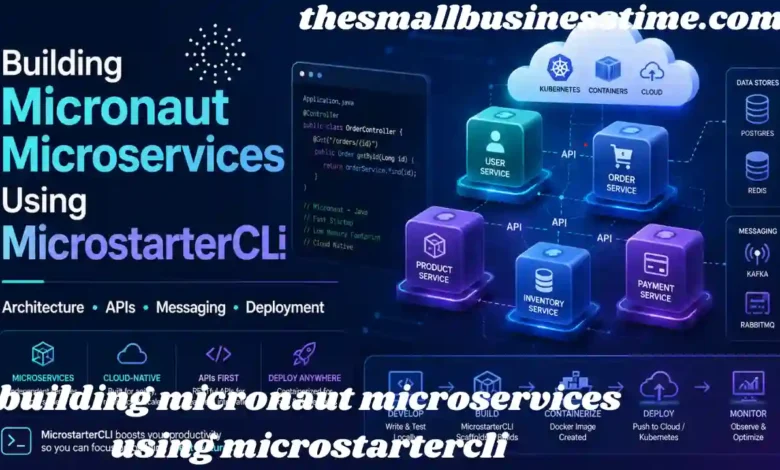
Modern software systems are increasingly expected to handle growing traffic, frequent updates, multiple integrations, and changing business requirements without becoming difficult to maintain. Microservices architecture has become one popular way of addressing these challenges because it allows a large application to be divided into smaller services that can be developed, tested, deployed, and scaled more independently. Within the Java ecosystem, Micronaut provides developers with a framework specifically designed for lightweight applications, microservices, cloud environments, and serverless workloads.
The idea behind building micronaut microservices using microstartercli is to combine Micronaut’s application-development capabilities with a command-line generation tool that reduces repetitive setup work. Rather than manually creating every entity, repository, controller, client, messaging component, security configuration, and supporting file, developers can use MicrostarterCLI to generate portions of the project structure from reusable templates. The MicrostarterCLI project describes itself as a rapid-development command-line tool for Micronaut applications and includes commands for several common application components.
This approach can be particularly useful when a development team needs to create several services that follow similar conventions. A microservices project may include product services, customer services, inventory services, payment services, notification services, analytics services, and other independent components. Repeating the same boilerplate structure for every service takes time and may create inconsistencies. A generation-oriented workflow can reduce that repetitive work while allowing developers to spend more effort on actual business logic.
This detailed guide explains what building micronaut microservices using microstartercli means, why developers might use the approach, how a typical architecture can be organized, what components are involved, and what practices should be considered when moving from generated code to production-ready microservices.
What Is Micronaut?
Micronaut is a JVM-based application framework created for building modular applications, microservices, serverless applications, and cloud-native systems. It supports commonly used JVM languages including Java, Kotlin, and Groovy. The framework provides features developers usually expect when creating modern backend applications, including dependency injection, configuration management, HTTP servers and clients, testing support, data access integrations, messaging integrations, security, service discovery, and observability.
Micronaut places strong emphasis on performing substantial framework processing during compilation rather than depending heavily on runtime reflection. This approach is intended to help applications start quickly and use resources efficiently, characteristics that can be valuable when many independent services are running simultaneously. The official framework documentation also provides project-generation capabilities through the Micronaut CLI, allowing developers to create applications and choose languages, build systems, testing frameworks, and application features.
Microservices environments can contain dozens or even hundreds of application instances. Resource efficiency therefore becomes important. A small reduction in startup time or memory usage for one application may seem minor, but the effect becomes more meaningful when the same architecture operates across many containers or cloud instances.
Micronaut can consequently serve as the underlying framework while MicrostarterCLI acts as an additional development accelerator.
What Is MicrostarterCLI?
MicrostarterCLI is a command-line development utility created to generate Micronaut application components and configuration from prepared templates. Its goal is not to replace Micronaut itself. Instead, it sits above normal framework development and helps automate frequently repeated tasks.
According to its project documentation, MicrostarterCLI includes capabilities involving initialization, configuration, entities, relationships, application events, messaging, security, metrics, and other generated components. Its documented messaging-related options include integrations around Kafka, RabbitMQ, NATS, and Google Cloud Pub/Sub.
A developer can think of MicrostarterCLI as a productivity layer. Micronaut supplies the framework capabilities, while MicrostarterCLI attempts to create common pieces of Micronaut code automatically.
For example, creating a basic CRUD feature manually may involve building an entity class, repository interface, service class, HTTP controller, client interface, validation rules, configuration, and tests. A generator can create a starting implementation for several of those pieces. Developers can then modify the generated code to reflect the actual business requirements.
That distinction is important. Generated code should normally be treated as a starting point rather than finished production logic.
Why Use Microservices Instead of One Large Application?
A traditional monolithic application places most business functionality inside a single deployable application. This structure can be effective, particularly for smaller systems. However, as a product grows, teams may encounter problems involving deployment coordination, scaling, development ownership, and fault isolation.
Microservices divide the application into smaller services based on business responsibilities.
Imagine an online marketplace. Instead of one enormous application handling every responsibility, the architecture might contain:
- Customer Service
- Product Service
- Inventory Service
- Order Service
- Payment Service
- Shipping Service
- Notification Service
- Recommendation Service
Each service handles a specific part of the overall business system.
This design can allow the inventory team to update Inventory Service without necessarily rebuilding the entire platform. Payment Service may be scaled differently from Notification Service. A failure in one component can also be isolated more effectively when the architecture has been designed correctly.
At the same time, microservices create new complexity. Developers must consider network communication, distributed transactions, monitoring, service discovery, security, configuration management, message brokers, failure handling, deployment automation, and data ownership.
Therefore, building micronaut microservices using microstartercli should not simply mean generating many small applications. Successful microservices require carefully defined boundaries and operational practices.
Understanding the Architecture Before Generating Code
Before creating the first service, developers should define the architecture of the system.
Consider a simple shopping platform consisting of four backend services:
Product Service manages product information.
Inventory Service tracks available stock.
Order Service manages customer orders.
Notification Service sends messages after important events.
The services could communicate through a combination of synchronous HTTP calls and asynchronous messages.
For example, Order Service might request product information directly from Product Service. After an order is completed, Order Service could publish an event. Inventory Service could consume the event and reduce stock, while Notification Service could consume the same event and send an order confirmation.
This is significantly better than creating services randomly and connecting them later.
Service boundaries, ownership, communication, failure behavior, and data responsibilities should be decided before substantial code generation begins.
Preparing the Development Environment
A typical Micronaut development environment requires a supported Java Development Kit, an IDE or code editor, and a build system such as Gradle or Maven.
Micronaut applications generated by its standard tooling can include Gradle or Maven wrappers, which means developers can often execute the project without separately installing the matching build tool globally. The framework CLI can also create applications using Java, Kotlin, or Groovy.
MicrostarterCLI must then be installed or made available according to the version and distribution being used. Because third-party development tools can evolve independently of Micronaut, teams should verify compatibility among their JDK version, Micronaut version, dependencies, build plugins, and MicrostarterCLI version before adopting a generated architecture.
This compatibility check becomes especially important for production projects. Code generators may contain templates written for particular versions of dependencies. Generated code should therefore always be reviewed rather than assumed to represent the newest framework conventions.
Creating a Workspace for Multiple Services
Keeping microservices organized from the beginning makes development much easier.
A project directory might look conceptually like this:
commerce-platform/
    product-service/
    inventory-service/
    order-service/
    notification-service/
    infrastructure/
    deployment/
Each service should ideally remain independently buildable.
The infrastructure directory may contain configuration for databases, message brokers, service discovery systems, observability tools, or local development containers.
The deployment directory may eventually contain container definitions, Kubernetes manifests, Helm charts, infrastructure scripts, or CI/CD-related configuration.
Even when MicrostarterCLI generates individual application components, good workspace organization remains the responsibility of the development team.
Creating the First Micronaut Service
A logical place to begin is Product Service.
The service may contain a Product entity with fields such as:
id
name
description
price
category
createdAt
updatedAt
The application needs several layers.
The entity represents the data model.
The repository handles persistence.
The service layer contains business logic.
The controller provides API endpoints.
The client may allow other Micronaut services to call the API.
Tests verify expected behavior.
MicrostarterCLI’s documented entity-generation workflow has been used to create combinations of entities, repositories, services, controllers, and client code for CRUD-style applications. Its project documentation includes examples where generated entity functionality is connected to Micronaut Data repositories and HTTP controllers.
The generated structure can save considerable setup time, but business rules must still be written manually.
For example, a generated ProductService might provide a basic save operation. A real application could require additional checks such as verifying category validity, preventing negative prices, normalizing product names, recording audit information, or publishing product-created events.
Automation creates the structure. Developers create the intelligence.
Building the Inventory Microservice
Inventory Service represents a different business responsibility.
Instead of copying Product Service and changing class names, the service should have its own domain model.
An InventoryItem might contain:
id
productId
quantityAvailable
quantityReserved
warehouseId
lastUpdated
This service owns inventory information.
Product Service should not directly modify Inventory Service’s database. Instead, communication should occur through APIs or events.
That principle is one of the most important ideas in microservices architecture: a service should maintain control of its own data.
If Product Service and Inventory Service directly modify the same database tables, they become tightly coupled even though they are deployed separately.
MicrostarterCLI can help developers generate the initial application pieces, but architectural independence must come from deliberate design decisions.
REST Communication Between Services
HTTP APIs are often the simplest method for synchronous service-to-service communication.
Suppose Order Service needs information about a product before accepting an order.
The interaction might conceptually look like this:
Client
   |
   v
Order Service
   |
   v
Product Service
Order Service requests product information, receives a response, validates the request, and continues processing.
Micronaut supports declarative HTTP clients, allowing developers to define client interfaces rather than manually constructing every request.
A simplified client could conceptually resemble:
@Client("product-service")
public interface ProductClient {

    @Get("/products/{id}")
    Product findById(Long id);
}
The exact implementation will depend on application configuration and the version of Micronaut being used, but the architectural principle remains the same: the client represents communication with another service.
Generated clients can reduce boilerplate, but developers still need to consider timeouts, retries, error handling, authentication, and fallback behavior.
Service Discovery in a Growing Architecture
Hard-coding addresses can work during early development.
For example:
product-service = localhost:8081
inventory-service = localhost:8082
order-service = localhost:8083
This approach becomes less practical in dynamic environments where service instances are created and removed automatically.
Service discovery allows applications to locate other services through registered service names rather than fixed addresses.
Micronaut provides integrations for service-discovery approaches such as Consul and Eureka. Current Micronaut guides demonstrate architectures where multiple services register with discovery infrastructure and communicate without relying entirely on hard-coded collaborator addresses.
In container-orchestration environments, platforms may also provide their own discovery mechanisms.
The important lesson is that service location should be treated as infrastructure configuration rather than embedded permanently inside application code.
Centralized and Environment-Specific Configuration
A microservices application requires many configuration values.
Examples include:
Database host
Database username
Database password
Message broker address
API credentials
Service ports
Feature flags
Logging configuration
External API endpoints
Security settings
Hard-coding these values is poor practice.
Development, testing, staging, and production usually require different values.
Micronaut supports environment-based and external configuration techniques, while distributed configuration systems can be introduced when necessary.
A team might maintain environments such as:
development
testing
staging
production
The code remains largely unchanged while configuration values differ.
MicrostarterCLI may help generate some configuration structures, but developers must establish policies for managing secrets and environment-specific settings securely.
Passwords and credentials should not simply be committed into source-control repositories.
Adding Database Persistence
Most microservices require persistent storage.
Product Service might use PostgreSQL.
Inventory Service might use another relational database.
Analytics Service might use an entirely different storage model.
One benefit of microservices is that every service does not necessarily need to share the same database technology.
Micronaut Data provides repository-oriented data access patterns. A generated repository can provide common persistence operations while allowing developers to define additional queries when necessary.
A typical service architecture becomes:
Controller
    |
Service
    |
Repository
    |
Database
Keeping these responsibilities separated improves maintainability.
The controller should focus on the HTTP layer.
The service should focus on business rules.
The repository should focus on data access.
MicrostarterCLI can generate portions of this pattern, but teams should review the generated classes and remove unnecessary code instead of accepting every generated feature automatically.
Event-Driven Communication
Synchronous HTTP is not appropriate for every interaction.
Consider what happens after an order is placed.
Several actions may follow:
- Reserve inventory
- Send confirmation
- Update analytics
- Start shipping preparation
- Record loyalty points
- Notify another business system
Order Service could make five synchronous HTTP calls, but this creates strong runtime dependencies.
An alternative is event-driven communication.
Order Service publishes:
OrderCreatedEventOther services subscribe independently.
Order Service
      |
      v
 Message Broker
   /    |     \
  v     v      v
Inventory Notification Analytics
Service   Service    Service
MicrostarterCLI’s documented messaging generation includes producer and listener/client-related components for technologies such as Kafka, RabbitMQ, NATS, and Google Cloud Pub/Sub.
Micronaut’s official guides also demonstrate asynchronous communication between microservices using technologies such as Kafka and RabbitMQ.
Event-driven design can improve decoupling, but it introduces additional considerations including duplicate messages, ordering, retry behavior, dead-letter handling, schema evolution, and eventual consistency.
Designing Entities Carefully
Code generation can make entity creation extremely quick.
That convenience creates a potential danger: developers may generate domain objects without properly defining the business domain.
Suppose an Order entity contains twenty unrelated fields because the team simply copied an old database table.
The resulting service may already have a weak domain model before development really begins.
A better approach is to define what the service owns.
Order Service might own:
Order
OrderItem
OrderStatus
OrderHistory
Payment Service might own:
Payment
PaymentTransaction
Refund
Shipping Service might own:
Shipment
DeliveryAddress
TrackingEvent
Even if customer information is needed in several services, that does not necessarily mean every service should share the Customer database table.
Microservices should exchange the information they require through clear interfaces.
Relationships Between Generated Entities
MicrostarterCLI documentation includes support for generating relationships between entities, including examples of one-to-one and one-to-many relationships.
Within a single service, entity relationships can be useful.
For example:
Order
  |
  +--- OrderItem
However, developers should be cautious about modeling relationships across service boundaries as if the system were one large relational database.
An Order entity should not require a direct database relationship with a Product record stored inside another independent service.
Instead, Order Service may store a product identifier and perhaps a snapshot of essential product information.
This preserves service independence.
Adding Security
Security should be designed from the beginning instead of added shortly before production.
A microservices platform may need:
- User authentication
- Service authentication
- Role-based authorization
- Token validation
- Secure API endpoints
- Secret management
- Transport encryption
- Audit logging
MicrostarterCLI documentation includes security-related generation options around common authentication approaches, including JWT-related configuration.
Generated security configuration should always be reviewed carefully.
Developers must understand which endpoints are public, which endpoints require authentication, which roles are permitted, how tokens are created, how tokens expire, and how service-to-service credentials are handled.
Security code is not an area where generated defaults should be accepted without evaluation.
Validation and Error Handling
Generated CRUD endpoints may technically work while still providing a poor API.
Imagine a product creation request:
{
  "name": "",
  "price": -900
}
A production service should reject invalid data.
Validation should enforce rules such as:
Product name cannot be empty.
Price cannot be negative.
Required values must exist.
Identifiers must use valid formats.
Error responses should also follow a consistent structure.
For example:
{
  "status": 400,
  "code": "INVALID_PRODUCT",
  "message": "Product price must be greater than zero"
}
Using predictable errors makes frontend development and service integration easier.
Generated code creates endpoints quickly, while validation turns those endpoints into reliable application interfaces.
Testing Generated Microservices
Generation should never replace testing.
A comprehensive testing strategy can include several levels.
Unit tests verify isolated business logic.
Repository tests verify database behavior.
Controller tests verify HTTP endpoints.
Integration tests verify multiple application layers working together.
Contract tests verify assumptions between services.
End-to-end tests verify important system workflows.
For Product Service, developers might test:
Create product successfully
Reject invalid product
Retrieve product
Update product
Delete product
Return correct response when product is missing
Order Service requires more complicated scenarios:
Create an order
Reject unavailable products
Handle Product Service failure
Handle Inventory Service timeout
Process duplicate events safely
The most valuable tests typically focus on business behavior rather than merely checking whether generated code compiles.
Observability and Metrics
A distributed system becomes difficult to operate without visibility.
If a customer reports that checkout took eight seconds, developers need to know where those eight seconds were spent.
Possible causes include:
Order Service
Database query
Product Service
Inventory Service
Payment provider
Message broker
Network latency
Microservices should therefore expose useful metrics, logs, health information, and tracing data.
MicrostarterCLI includes documented metrics-oriented generation capabilities, while the Micronaut ecosystem supports monitoring and distributed tracing integrations.
A production observability strategy commonly includes:
- Structured application logs
- Request identifiers
- Service health endpoints
- Latency metrics
- Error-rate monitoring
- Database metrics
- Message-processing metrics
- Distributed traces
These capabilities make it possible to understand behavior across multiple services instead of examining isolated log files.
Containerizing Micronaut Microservices
Once services work locally, they often need to be packaged for deployment.
Containers provide a standardized way to package each application with the environment it requires.
A system may create separate container images for:
product-service
inventory-service
order-service
notification-service
These images can then run through container platforms or orchestration systems.
The benefit is operational consistency. Development, testing, staging, and production can use similar application packaging.
However, containerization does not automatically make an application cloud-ready.
Services still require appropriate health checks, graceful shutdown handling, external configuration, resource limits, observability, and resilience.
Scaling Individual Services
One of the strongest reasons for using microservices is independent scaling.
Suppose Product Service receives 20 times more requests than Notification Service.
A monolithic application may require scaling the entire application.
Microservices allow additional Product Service instances to be created without necessarily creating additional instances of every other service.
For example:
Product Service: 10 instances
Inventory Service: 5 instances
Order Service: 6 instances
Notification Service: 2 instances
This flexibility can improve infrastructure efficiency.
It also makes stateless service design valuable. If any service instance can process a request, scaling becomes easier than when application state is stored only inside one particular server process.
Common Mistakes When building micronaut microservices using microstartercli
A code generator can accelerate development, but speed can also encourage architectural shortcuts.
One common mistake is generating too many services.
Not every entity needs its own microservice.
Creating Customer Service, Address Service, Phone Service, Email Service, and CustomerPreference Service simply because separate entities exist may result in unnecessary network communication and operational complexity.
Another mistake is treating generated code as production-ready code.
Templates cannot fully understand business requirements.
Another problem is sharing one database between every service.
This creates hidden coupling.
Developers may also forget network failure handling. Calling another service is different from calling a local Java method because the remote service may be unavailable, slow, overloaded, or unreachable.
Additional mistakes include inconsistent APIs, insufficient logging, missing monitoring, weak authentication, storing secrets inside source code, and introducing message brokers without understanding asynchronous failure behavior.
MicrostarterCLI Versus the Standard Micronaut CLI
It is helpful to distinguish between Micronaut’s official CLI and MicrostarterCLI.
The standard Micronaut CLI provides official project-generation commands and can generate several application and framework artifacts. Micronaut’s current documentation describes commands for creating standard applications, CLI applications, functions, gRPC applications, messaging applications, controllers, clients, and other framework components.
MicrostarterCLI is a separate project designed to automate additional development patterns using templates.
Therefore, developers evaluating building micronaut microservices using microstartercli should determine which responsibilities should be handled by official Micronaut tooling and which additional generation tasks MicrostarterCLI provides value for.
This distinction is particularly important when framework versions change.
A team should avoid becoming dependent on generated templates it cannot maintain itself.
A Practical Development Workflow
A sensible workflow for building micronaut microservices using microstartercli might begin by defining business domains rather than immediately generating applications.
The team first identifies services such as Products, Inventory, Orders, Payments, and Notifications.
Next, it defines which service owns which data.
Then it determines how services communicate.
Simple request-response interactions may use HTTP.
Background workflows may use events.
After the architecture is defined, the team can create Micronaut applications and use MicrostarterCLI where appropriate to generate repetitive components.
The generated application should then be reviewed.
Business logic is added.
Validation is implemented.
Error responses are standardized.
Security is configured.
Unit and integration tests are created.
Metrics and logging are added.
The services are tested together locally.
Container images are built.
Finally, the platform is deployed through an automated pipeline.
This sequence keeps generation in its proper role: accelerating implementation rather than replacing architecture.
Benefits of building micronaut microservices using microstartercli
The largest advantage is development speed.
Creating the same repository, controller, service, client, messaging producer, and listener patterns repeatedly consumes developer time.
Generation reduces repetitive typing.
Another advantage is consistency.
When multiple developers manually create similar components, naming patterns and project structures may gradually become inconsistent. Templates can create a common starting structure.
Onboarding can also become easier because new developers can begin with predefined patterns instead of learning every boilerplate step immediately.
MicrostarterCLI may also encourage experimentation. Developers can prototype new services quickly and learn how common Micronaut components fit together.
The benefit is greatest when teams understand the generated code rather than treating generation as a substitute for framework knowledge.
Limitations and Important Considerations
MicrostarterCLI is not the Micronaut framework itself, and teams should distinguish community tooling from official framework functionality.
Compatibility deserves special attention.
Micronaut, Java, database libraries, messaging clients, security libraries, and Gradle or Maven plugins continue evolving. A generated template created for one combination of versions may require modification when used with another.
Teams should therefore test generated projects through automated builds.
Generated dependencies should be reviewed.
Deprecated APIs should be replaced.
Security settings should be inspected.
Production architecture should not depend on a tool unless the organization is prepared to maintain the resulting code if that tool changes or stops receiving updates.
For long-lived commercial systems, generated source code is generally safer when developers fully own and understand the generated output.
When This Approach Makes Sense
building micronaut microservices using microstartercli can be especially attractive for teams building multiple JVM services with repeated architecture patterns.
It may work well for:
- Internal business platforms
- SaaS backends
- API-based systems
- Event-driven applications
- Cloud-native applications
- Rapid prototypes
- Administrative services
- Distributed commerce systems
- Data-processing services
It can also be useful for developers learning Micronaut because generated components provide concrete examples of how controllers, repositories, services, clients, events, and messaging pieces connect.
However, very small applications may not require microservices at all.
Sometimes a well-designed modular monolith provides simpler deployment, easier transactions, and lower operational overhead.
Technology should follow business requirements instead of architecture trends.
Future-Proofing the Architecture
Microservices evolve.
Service interfaces change.
Events gain new fields.
Databases grow.
Traffic patterns shift.
Framework versions change.
The architecture should therefore avoid assumptions that make future modifications unnecessarily expensive.
APIs should use clear contracts.
Events should support schema evolution.
Database migrations should be automated.
Services should remain independently testable.
Configuration should remain external.
Deployment should be automated.
Observability should be included from the beginning.
Generated code should be treated as application-owned code after creation.
These practices ensure that MicrostarterCLI remains a productivity tool rather than becoming a hidden architectural dependency.
Final Thoughts
building micronaut microservices using microstartercli offers an interesting approach to accelerating Micronaut development by combining a lightweight JVM framework with automated generation of commonly repeated application components. MicrostarterCLI can help developers create starting structures for entities, repositories, services, controllers, clients, relationships, messaging components, events, security features, and metrics-related configuration, reducing the amount of boilerplate that must be created manually.
The real value, however, comes from what developers do after generation.
A successful microservices system requires more than many generated projects. It requires carefully selected service boundaries, independent data ownership, reliable communication, consistent APIs, event design, security, validation, automated testing, metrics, centralized logging, distributed tracing, configuration management, resilience, containerization, and deployment automation.
Developers considering building micronaut microservices using microstartercli should therefore view MicrostarterCLI as an accelerator rather than an architect. It can create common pieces quickly, but humans must still determine how services should interact and which business rules belong inside each service.
When used with that understanding, the approach can significantly reduce repetitive development work. Teams can establish reusable patterns, prototype services faster, maintain more consistent application structures, and spend more time solving the business problems that actually differentiate their software.
Micronaut provides the foundation for building efficient JVM services, while MicrostarterCLI can provide an additional layer of automation for recurring development tasks. Together, they can support a productive microservices workflow when the generated code is reviewed, tested, secured, maintained, and adapted to the requirements of the system.
Ultimately, the strongest strategy for building micronaut microservices using microstartercli is not to generate as much code as possible. It is to automate predictable work while keeping architecture, domain design, security, reliability, and business logic firmly under developer control.
ALSO READ : PlugboxLinux Contact – Complete Support and Contact Guide